
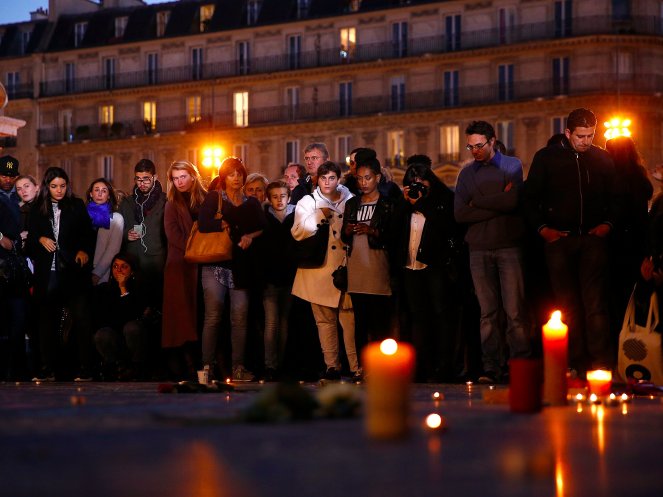
Days after the brutal and devastating attacks in the French capital, we can begin to discuss the range of responses from figures across Europe, and decide what this means going forward. The attacks in Paris have an air of more than what happened in January with Charlie Hebdo, an atmosphere different from anything we’ve seen before, and that’s not just because we are still reeling from the sheer tragedy of it. Not only is this the first strike in the heart of Europe for a decade, but it was indiscriminate killing in a way that challenges everything we believe in Europe; tolerance, freedoms, democracy and justice. The victims face none of these abstract concepts now – victims of violence, terror, intolerance and hatred. But what’s important now is not just the mourning, but how we as Europeans are going to react moving forward.
As a disclaimer I would like to say that I understand this is a very sensitive issue being less than a week after the attacks in Paris and I will therefore proceed in as humane and considerate a way as possible. This is still a time of mourning; however that makes the issue all the more important.
The number of issues the Paris bombings affect is quite astonishing, as it is a coming together, as it signals the coming together on many unresolved issues that have been plaguing Europe and the wider world for several of the past months and years. However there are 4 distinct areas they focus on.
Firstly, we have the calls of European politicians, in the Parliament as well as France and Germany for European solidarity and cohesion in these dark times. Angela Merkel’s statement following the crisis was riddled – and quite rightly I’d say nonetheless – with the rhetoric of European solidarity. However in practical terms, this could mean many things, and hopefully more than “liberal-humanitarian bullshit” as Slawoj Zizek would call it. Guy Verhofstadt, leader of the ALDE Group in the European Parliament, wrote in the Guardian on Monday that “borderless terrorism can only be tackled by borderless intelligence” essentially advocating for a true integration of intelligence gathered by European secret services, in order to ensure that nothing slips through the gaps. It is true that, as with many of the reasons in favour of the EU, terrorism in a threat which transcends borders and runs rings around nation states. It is not something that can be dealt with at the national level effectively, and therefore means the closer those states can operate at a more transnational level, the better. However there is a reason, as Ronja Kempin – researcher at the German think-tank SWP – pointed out in the FAZ on Tuesday, why this area of defence and security policy is one of the weakest areas of EU integration – it’s going to require a lot of swallowing of national pride and an enormous pooling (or restriction as the Farages and Le Pens of Europe will call it) of national sovereignty. As if the question of Europe wasn’t precarious enough, this is the path Verhofstadt and his partners Pitella and Weber in the European Parliament have chosen. Perhaps this is the time, perhaps this isn’t the time for talks of closer cooperation and integration, but regardless, it will play easily into the hands of the Eurosceptic right.
Despite this, many, including Francois Hollande in his address to the Congrès du Parlement français at Versailles on Monday, have supported the idea of strengthening European-level cooperation in this area. Along with strengthening of the external borders of the EU, a clamp down on the illegal weapons trade in Europe, and a passing of EU legislation that would allow the automatic transmission of airline passenger-data to their destination country, this is the package of legislation that we Europeans have lined up for us. On Friday, EU interior ministers are holding an emergency session to discuss the implementation of these policies; Bernard Cazeneuve has said that a strengthening of the Schengen Area’s external borders will be the most effective course of action. Regardless of this, I doubt the powers that be will realise the impact of even the potential of these reforms on the already sceptical peoples of Europe, in particular those aforementioned Farages, Le Pens, AfDs and so on. Not only is this more Europe, but its more ‘superstate’-esque Europe, and that will resonate in the Union.
However, before I get onto the eurosceptics, we must take a look at the second outcome of Friday’s events, specifically Hollande’s desire to step up the war in the Middle East. Hollande and many in the French government’s idea of solidarité is more than calls for reforms. As Kepin told the FAZ, “France now wants to see more from the EU member-states than just statements of solidarity, and the usual politics of small steps”. It wants a real response from Europe. To that end, the French government incited Article 42 of the Lisbon Treaty, calling upon the member-states for explicitly military support in times of crisis. Now, bear in mind that this is not a true, legal obligation, more of a reminder of moral obligations to your allies. But it’s also worth remembering that this clause has never been invoked and few people are sure what it could mean in real terms. If not physical military support, then perhaps increased funding from the EU towards France’s campaign against IS? Or instead, France could call for a European equivalent of a ‘Coalition of the Willing’, meaning that those who are willing to join them will trot off to fight IS together. British PM, David Cameron, is already trying to drum up support in the Commons for permission to begin operations against IS in Syria, and it seems as if, in the wake of the Paris attacks, the tide is turning towards that of war. Cazeneuve said on Monday, in a further addition to the broiling cauldron of jingoist rhetoric “The terrorists will never destroy the Republic, because it is the Republic that will destroy them.” Even in the European Parliament, in support of France and other nations’ amazing moves to begin a rapprochement with Russia, the S&D Group has called for the “Spirit of the Helsinki Agreement” to return to our continent, and to make overtures towards an acceptance of Russia’s recent actions, including their intervention in Ukraine, Syria, and demands to keep Assad around just a little bit longer.
Again however, I am sceptical. It must be remembered that – despite the French government’s assertions that it is now at war with IS, France has been bombing IS in Syria for a long time now. Over the past year, operations in the region have become more and more aggressive. And the result of that? The attack on Friday. And I am by no means blaming France for the barbarism of Islamist fundamentalists, however, I think it’s more than clear that bombing hasn’t worked, and I sincerely doubt it will. Like any right-wing backlash against Muslims for the actions of IS, bombing leads to more Muslims being marginalised and demonised by society, by the west, and so on, to the point where they join those forces who are fighting in their never-ending Jihad against the western world. Deaths which cannot be predicted, which destroy countless lives unintentionally, do not win the fight raging at the heart of Islam today, between the majority of peaceful people, and the all-too-rapidly expanding minority of fundamentalists – it only serves to aggravate it. Every violent and militaristic policy pursued since 2001 in the Middle East have only worsened the state of affairs there, not improved them. And that is not saying that military action in some form, some bringing to justice of the perpetrators, and IS as a whole is not necessary. It’s saying that bombing the middle east is not the way to solve the problem there alone. It must be taken together with some other, more broad and more developed plan to restore order to the region. Restore order. Not simply break the old ones. Thankfully, certain steps were taken at the Vienna last week to begin building a plan towards a thought out return to peace in the region.
Of course we now get to the Eurosceptics – hooray. Naturally, in the aftermath of the attacks on Friday, there has been a wave of anti-Muslim and anti-refugee rhetoric. This was further aggravated by the fact that a Syrian passport traceable back to a refugee who entered Greece in early October was found near one of the terrorists last Friday. It is widely assumed that Le Pen’s Front National are going to make powerful gains in the coming regional elections in France. Add this to the fact that European politicians want a further integration of powers at the European level will only add fuel to the fire that is raging in Europe over the EU. No doubt I agree that it is the right course of action in terms of solving the problem of terrorist threats in Europe. However it will not do the pro-Europe argument any favours in the immediate term. Furthermore, France – however correct they were in their actions – has become the latest in a long list of European Schengen Adherents to implement border controls. Of course, this does not conflict with the clauses of the Schengen Agreement, however it further adds to the right-wing’s arguments that the Schengen Area is dying a slow death, it’s unsustainable, it only heightens the threat of a terrorist attack etc. Viktor Orban is also among this bunch who claimed to the Hungarian parliament on Monday “It’s alarming to consider how many terrorists have crossed through our lands. It’s time to put an end to this”. As if there couldn’t be more right-wingers coming out of the wood-works to add their incendiary remarks to the fire, Nicolas Sarkozy said he would want to “expel some radical imams” from the country and vowed to electronically tag the 11,500 people on France’s extremist watch-list.
There are two key points to be made here; firstly – as France 24 pointed out in an article on Monday, the likelihood that the Syrian passport was forged is very high, this according to both a US intelligence official and the French Minister of Justice Christiane Taubira. A Dutch journalist highlighted earlier this year the ease of getting a forged Syrian passport, and furthermore the identification numbers were incorrect and the picture did not match the name. Secondly, and perhaps more dishearteningly for the state of European attempts at integration of minorities, the majority of the perpetrators were Europeans, French nationals – homegrown. They didn’t need to ship people in from abroad, because Muslims in Europe felt so disconnected from the system, from their society, that they would take part in the slaughter of their fellow, innocent citizens willingly. Of course, none of the right are going to pay attention to this, they’ll simply continue as they do, blaming the refugees, and open-door policies – tolerance and respect in the face of violence and hate. One saving grace of European politics is that many have pointed out, like German EPP Group member Elmar Brok, that “Refugees are the victims of terror, not part of the terror.” However they’re not going to stay like that if you stoke up anti-Muslim feeling.
I suppose as a last point is the fact that much of Europe has had a very immediate, unconsidered reaction to the Paris attacks that is likely going to lead down a dark path. The values of the enlightenment, of rationality, of tolerance, of secularism, of justice, of freedom are all under threat from the reaction of states who have got a growing populist right-wing on the one hand, being fed by failing policies on the other. France entered a state of emergency on Friday, which allowed over the weekend 168 raids to take place in France, leading to the seizure of weapons and the arrests of 23 people. Now that may seem all well and good, but viewed in the clearly developing context of potential restrictions of personal freedoms in terms of right to public gathering on the one hand and privacy on the other, closing of public venues, right to impose curfews, closer cooperation of European intelligence agencies, closing of EU external and internal borders, increased surveillance and monitoring, and most visibly the request by the Hollande government to extend the ‘State of Emergency’ by 3 months, they seem disconcerting at best. Ranja Kempin said in the FAZ yesterday that Europe and particularly France risks going down the same path of the United States after September 11th. Is that the right path? Yanis Varoufakis said in the discussion (Europe is Kaput, Long Live Europe) at the Royal Festival Hall, London on Monday that Europe has to ask itself the question – are we strong enough to stand up for our values in the face of terror? The values of free movement, and freedom, justice and tolerance? Because this is key to the debate going forward. We Europeans have to stand up for our way of life. We cannot be terrified into throwing away the very rights and freedoms that IS fights with the West over.
Parisians, French men and women, Europeans, we cannot give in to the actions of terror, and violence. Nor can we give in to the reactionary response of fear, and control. We must remain united, and we must consider the outcome of our decisions as we move forward. There are many simple things which have been tried and did not work in the past which we run the risk of repeating. Instead, there has to be a reasoned through discussion on how to truly affect a change in a way that leads to a truly long-term, positive outcome. Which may well include retribution. But to the right people – the radicalised extremists, not the innocent civilians right next door. And once we’re done with retribution, we must be able to go to those civilians, having had a large role in the tearing down of their lives, and tell them how we’re going to help them rebuild them.
Now, lastly, I just want to make a short digression on whether this is the ‘right time’ to be talking about the politics, seeing as people have died, we still have people in mourning, how can we reduce these people’s lives to evidence in an argument? I don’t believe that in the aftermath of such an event, you can simply ignore its significance in the wider context; the clear failure of previous actions, the obvious desire for a rethink to come up with new ones, the fact that these events do mean something more than just the deaths of loved ones needlessly. They represent also the need for a change so it doesn’t happen again and that means we have to look at these events, see how we went wrong, and decide how to change them. We need to. To ignore it at the time when it’s most relevant would be to do the victims an injustice. Now I have had an initial negative reaction to a comment on Facebook I read saying that it was too soon to discuss the politics of the attacks on Friday. And that it because I usually hear this line come out of the mouth of people like Republicans in America who don’t want to acknowledge in ineffectiveness of their gun regulation for example, and the need for new regulation to fix the problem. However in this case it was different. It was clear that he said it out of a true emotional response to traumatic events that we all witnessed in some form or other on Friday. He did not want to see the victims of such a tragic attack be turned into mere statistics to be used to support politicians’ arguments. And he is right. Mourning is important. We cannot immediately move past the mourning period, and forget the lives that were lost. But likewise, we cannot let the chance for a debate and discussion on how to move forward slip away and also become forgotten. Because that would also be a tragedy.
German Foreign Minister Frank-Walter Steinmeier said on Monday “There are no obvious recipes for tackling terrorism”. However that simply means we need to discuss how to solve the issue longer.
 Sources: FT, FAZ, France 24, The Guardian, S&D Group Website, ALDE Party Website, European Parliament Website, Europe is Kaput, Long Live Europe talk

