
The British House of Commons backed Prime Minister David Cameron’s motion to extend Britain’s air-strikes to Syria, in a vote that is reflecting the response of many of Europe’s leaders to IS’ attack on Paris on 13th November and the rising threat of the jihadist group to the west.
On Wednesday, following his speech in favour of attacks on Monday, David Cameron held a vote in the House of Commons to give a mandate to his policy to begin attacking IS in Syria. The vote was passed with a majority of 174, including many labour dissenters, Liberal Democrats and the Northern Irish Democratic Unionist Party. Only 223 parliamentarians voted against attacks, representing a persistent level of scepticism in the country that bombing will not work to reduce the threat of IS. The opposition was made up of the majority of Labour MPs, the Scottish National Party, the Green Party MP as well as 2 Plaid Cymru members.
Britain’s foreign policy in the Middle East
Britain has been bombing IS targets in Iraq since last year, however the Prime Minister has shied away up until now from expanding British intervention to Syria after his defeat in the Commons in 2013 over bombing the Assad regime in Syria. Cameron said prior to the vote, having advocated for it for months now, that he would only hold a vote if he was sure he’d get a majority. Clearly, he wanted to avoid defeat again. The debate on the subject lasted ten and a half hours, and demonstrated clear divisions in the line of thinking of British politicians. One of the major outcomes of the debate was the sheer split in the labour party, with a large number of Labour politicians, including members of Jeremy Corbyn’s shadow cabinet, defecting on the issue and voting with the government. This issue of which way labour parliamentarians would vote had been playing out in the days prior to the vote on Wednesday, culminating in Corbyn giving his MPs a free vote. The final tally left 66 Labour MPs voting with the government against their leader, including shadow Foreign Secretary Hilary Benn, First Secretary of State Angela Eagle, and Deputy Leader of the Labour party Tom Watson. Hilary Benn himself gave an impassioned speech in favour of attacks. Meanwhile David Cameron faced 7 rebels of his own.
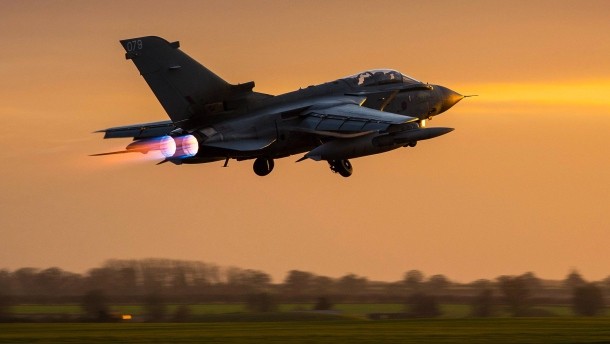
British attacks on IS ion Syria began almost immediately after the vote was passed; at 3am that morning British bombs began falling on IS targets, including IS controlled oil fields. RAF tornado fighters were operating out of bases in Cyprus. The FT reported on Thursday that Michael Fallon, British Secretary for Defence, stated that the RAF would be doubling its presence in Cyprus, as well as announcing the beginning of British attacks on the jihadist group. Oil has been a more recent target of the US led coalition, considering that it is a major source of revenue for IS; IS controlled oil fields sell oil earning millions of dollars on the black market both domestically and overseas. Former Chief of the Defence Staff, Sir Michael Graydon, told the BBC that on this first occasion “the targets will have been carefully identified”. He also said that other potential targets will be IS tanks and logistical locations.
This was received well by the French President’s Office, which welcomed the news of support from the British Parliament. This European drive towards more aggressive action in the Middle East was triggered by the French government, having called its European allies to arms in the wake of the attacks in the French capital Paris, in a bid to expand the resources at the disposal of the coalition fighting IS. France began its air strikes against IS in Iraq last year, expanding these to Syria in September 2015. At the same time as the British debate meanwhile, the German Bundesregierung also approved plans to deploy 1,200 troops of the German Army to the Middle East to combat IS, including a warship and fighter jets. This will also have to be debated and approved by the German Bundestag. In the British debate, among other criticisms of attacks was the problem of a lack of strategy, especially an exit strategy. One of the 5 points the Lib Dem letter to David Cameron before the vote was about the importance of a wider strategy in Syria, however despite a lack of a clear strategy to rebuild Syria after the defeat of IS, they voted in favour of attacks.
A real strategy for Syria?
Now coming to the most important part of this story; is bombing IS in the Middle East an intelligent and effective strategy to end the threat? From a global perspective, no, it’s not. Going to war in the Middle East is, as the last 15 years of western intervention in the region has shown. Getting involved in local politics inevitably paints the west as the enemy, and any kind of military force will lead to that happening to some degree. When it comes to bombing however, my opinion is even worse, because it is a half-measure, a seemingly meaningful response but effective non-solution. Air strikes is western regimes’ card to pull to make them look tough without actually committing ground troops to the fight – it’s remote, hands-off, impersonal, non-committal. Nothing about air strikes works – it does not dismantle the opposing force, who can melt away and go underground, it certainly serves to stir up local moderates against the west through what is termed ‘collateral damage’, it’s not accurate, it’s not constructive, it isn’t a long term solution. That is absolutely true when the policy is employed on its own. France has been bombing IS for months in Syria, and a year in Iraq, and it got them nothing, worse than nothing. American bombs have been falling for over a year on IS, and to what end? It’s only served to increase support for the jihadists. Over 5,000 bombs have been dropped by America on IS, and they are no closer to being defeated, their ideology is no closer to being eradicated than a year ago.
I mentioned invasions before, and personally I believe that if you are absolutely committed to intervention and air strikes, then you must have ground forces to back up and exploit the advantages gained by those air strikes. But as I said before, no one’s going to provide that because no country wants to send armies to fight in the Middle East any more, because they know how destructive that is. And no jingoists will say “well, there are the local forces fighting IS, why can’t they be the boots on the ground?” And that’s precisely why; because there are forces – plural. The Kurds fight IS, but they also fight out ally Turkey, who are fighting IS, and the Assad regime. The Assad regime, with the support of Russia, is fighting the local rebels, Kurds, IS and just about everyone else. We’re supposed to be working with Russia now, except Turkey – our ally in the region – shot down one of their planes, burning that bridge to ashes. To think it would be remotely possible to bring all these forces into line, to forget their personal grievances, in the face of a wider enemy is absolutely impossible. And perhaps given time it would be slightly more possible, except the whole point of opting for air strikes now is that it’s a fast, lightning response. No talking, no thinking just go, bomb them. What happens after? Who cares, we can’t look weak.
This is the entire point of the strategy, if it can even be called that. A quick fix, mainly to domestic fears, to show that the government is “doing something”, not any kind of solution to the heart of the problem – the Middle East. You cannot pretend that this is a well oiled coalition, going out to fight in cooperation with the local ground forces. That is simply not what is happening right now. And anyone who kids themselves and says “we know who we’re bombing; it’s an accurate science” has no idea what they are talking about. Just look at the hospital in Kunduz, look at the homes that have been destroyed in Syria. You think they know who they’re bombing? Maybe. You think they know, and it works? That’s lying to yourself.
With the British decision on Wednesday however, it is more complicated – there are other factors at play which are more important. Firstly, Britain is already bombing IS, in Iraq. To say that we have to stay out of Syria, when the target themself does not recognise the border between Syria and Iraq makes no sense. People who are anti-intervention have missed their chance unfortunately; we’re already in the war and we’re already bombing, so placing this restriction on the RAF makes no sense, as does believing anything real has changed. Secondly, France directly appealed to Britain (as a member of the EU) for support in the matter. To reject such an appeal would not play well with our partners, for our standing in the world and the meaning of Britain’s commitments. Especially considering we are already active in Iraq, stopping short of Syria seems strange. It’s not a matter of pursuing the policy as a solution, but as holding to a promise we have made, however unfortunate a promise that is. The argument that Britain would expect France to come to our aid, were our positions reversed, is an intelligent one. It would look especially bad in the light of the recent UN Security Council resolution that all nations should do everything in their power to defeat IS. Britain needed in this case to bite the bullet and enter the conflict in Syria, however meaningless that will turn out to be.
Therefore, it is not the policy of bombing to solve the Middle East’s problems that I agree with, but the policy of supporting our allies and holding to international commitments. It doesn’t matter who tells you, turning our back on world affairs would not be the right course. In the current international context, it does make sense for Britain to extend air strikes to Syria. However if you had asked me last year, before the bombing had even started if this was the right course of action, I would have said no, absolutely vote against, it’ll lead to nothing. However now, there’s little doubt that in holding to our international commitments, the situation doesn’t change much, but Britain remains and active player in the conflict, which, if we want to affect the situation at all, is necessary.
Sources: The Guardian, FT, FAZ, France 24, BBC

