
As we have seen over the past months, some serious changes made by the now reigning Prawo i Sprawiedliwość party (PiS) have caused a shift in the governance of Poland; one significant enough for European Commission and Poland’s neighbours to take notice of. Most critically, PiS, led by Jarosław Kaczyński, who hold both the Presidency (Andrzej Duda) and control the legislative (with a majority in the Sejm and the Senat, led by Prime Minister Beata Szydło) has attacked two major pillars of European democracy -the freedom of the press, and the independence of the judiciary. However when reviewing these developments, we must take them in the wider context of Poland’s neighbours; just how divergent a path has PiS taken, and is this a real threat to democracy in Poland?
Naturally, the first comparison taken by most looking at the Polish case is Hungary. Ever since Viktor Orbán was returned to power with his Fidesz party in 2010, he has clearly undermined the checks and balances in the Hungarian system of governance, taking advantage of the constitutional majority he won in the 2010 elections. This allowed him to amend the constitution as to attack the freedom of the press, undermine the power of the independent judiciary, and thus cement his and his party’s power permanently. According to a paper published by the Legatum Institute – Is Transition Reversible – and written by Anton Shekhovtsov, 80% of the population in Hungary have access only to Fidesz dominated media. By looking at Orbán’s actions, we can clearly see the same steps being taken by Kaczyński’s PiS, with seemingly the same intention; to permanently undermine democracy so as to cement their grip on power. Kaczyński himself has said he admires the ‘illiberal democracy’ built by his southern neighbour. Furthermore, he has a deep distrust of Germany and western liberalism. By replacing judges on the Constitutional Tribunal with their own nominations, replacing News editors and executives in the same style, and limiting the Judiciary’s ability to stop legislation passed by the PiS controlled Sejm. Of course, these are authoritarian moves and represent a real threat to the vibrant democracy that had grown in Poland since the fall of the communist government in 1989.
The Guardian reported on Monday the judgement of the Council of Europe’s Venice Commission, which monitors the strength of democratic governments, particularly in the area of the Rule of Law, or Rechtsstaat as it is termed in German. In a leaked draft, the Venice Commission stated that they were to advise the Polish government to strike out the provisions reforming the country’s Constitutional Tribunal, as a threat to the Rule of Law in the country. As some of Europe’s leading constitutional experts, I think the Venice Commission’s judgement can be respected. My real question is, how different is this from other parts of Europe? I think the answer to this question is a little more complex than it seems.
My initial thoughts on this topic were motivated by an article in the FAZ, in which the Polish Justice Minister, Zbigniew Ziobro, was interviewed particularly about the freedom of the Polish press. The Minister’s previous statements about Germany feature prominently in the interview, particularly about the fact that the German press, complicit by all accounts with the local Police, covered up the sexual assaults which took place in Cologne on New Year’s Eve. Whilst at first you might dismiss this comment as the ramblings of a prejudiced man, there is some grain of argument here. The fact is, the press in Germany actively did not cover this critical piece of news until days after the event took place. Furthermore, this was supported by a lack of noise from the officials’ side, as Police statements on the events in Cologne were at first vague. Now, I originally said a grain of argument because the fact is, Germany’s press and media have not been completely been taken over by the government, with the chief editors and executives of ARD being appointed by the Chancellor. This is the case in Poland. However, the press did act in concert with the police and local government to cover up critical news, which isn’t just supporting the government line, but actively manipulating the news. I’m not a conspiracy theorist; it’s more than acceptable to suggest that figures in the German media are actively supportive of the establishment and the government – they are willing to tow the Chancellor’s line, attack her opponents, support the establishment and generally argue a right-wing line. However what happened in the wake of the Cologne Assaults was more than that – the press was actively complicit with government officials in covering up news. There’s a problem here, with both the fact that the media often is pro-establishment, and the complicit covering up of news; in both cases, the media is acting on behalf of the government, as in the Polish case, and not challenging it.
The former point is more clearly seen in Brtiain – almost all the press is right-wing, with The Guardian, The Independent and the Mirror having a more leftist bias. Rupert Murdoch owns huge sections of the British media, including Sky, The Times, The Sun, and previously when it was still printing The News of the World. Who allowed him such influence in the British press? None other than Prime Minister Margaret Thatcher, who, knowing he would encourage his papers to tow the government line, stopped the monopolies commission from investigating from investigating Murdoch’s take-overs and mergers. What happened next? The Sun actively supported Thatcher’s policies throughout the 80s, with headlines such as “Gotcha!” when Britain sunk the General Belgrano during the Falklands War. Also, the paper reported the Hillsborough disaster in 1989 exactly according to the police statement on the issue, without any journalist investigation or questioning whatsoever. Afterwards, it was discovered the police statement was wrong and almost certainly a cover-up. Pro-government perhaps? Now, the argument can be made that these papers etc. have freely chosen to support the government – some may go even further and say ‘having reviewed all the facts’, though that would be nonsense in the case of Murdoch in the UK. Returning to Germany – are the German press under the control of the government? Likely not. Certainly not like Poland. However, they have supported the government’s line, or at least the establishment’s line on many occasions. As I said before, it is arguable that they have freely chosen to do this, however how do we know? How do we know who isn’t bought off, who hasn’t participated in cover-ups, what is being left out, and who is complicit in not challenging the government? Ultimately, this is the press’ job, right? To challenge the government, to hold them to account and to provide all the facts for the population at large to also challenge the government. This is a key pillar in democracy, and whilst the Poles haven’t found the way forward with their statist, authoritarian method “ensuring the media reports the facts”, western media isn’t entirely perfect either. How does one ensure an objective press? Not by government take-over. And ultimately, humans will be humans and we all have our biases. I believe the press should be an opinion former, not merely neutral and passive observer; but not at the cost of the facts.
Turning to the rule of law, it’s certainly interesting to compare the situation in Poland with my own government. There are naturally differences, but in Britain, like in Poland right now, the primacy of parliament as the chief arm of government is almost absolute. To the extent that the highest court in Britain right up until 2009 was a part of the House of Lords. Furthermore, even today, the Supreme Court of the UK cannot stop primary legislation made by the Parliament, regardless of how authoritarian or undemocratic it might be, in clear contrast to the Constitutional Courts of the rest of Europe. When compared to the Federal Constitutional Court in Germany, the UK Supreme Court looks like a child. At best, it can issue a declaration of incompatibility, when it comes to Human Rights’ violations – however this does not have to be followed by the government. It cannot overturn Secondary legislation unless that legislation is found to be ultra vires or outside the power of the legitimising primary legislation. And this type of legislation is usually put forward by Ministers alone and only debated in the House of Lords! Thus, in truth, in Britain there are no checks on the powers of parliament. Now, naturally, the situation is different; though some may debate this, there are currently no parties in parliament who want to overturn British democracy, and a powerful civil society would mean that undemocratic moves by an authoritarian Prime Minister would be held in check – in theory at least. Yes, Britain has a long tradition of upholding the rule of law ever-since the English Civil Wars in the 17th Century. However the question must be asked – such a weak supreme court as Poland has created is not new by any means in Europe.
Finally, we turn to the French State of Emergency, which was recently extended by another 3-months by the French Parliament. Now a State of Emergency in France seriously cuts back on civic freedoms, including restrictions on public gatherings, house searches without warrants, the empowering of unelected prefects to impose curfews and close places of gathering etc. Of course, this is a state of emergency, but ultimately, there’s no limit on how long the state can be prolonged (so long as it’s approved by parliament) and it undermines democratic freedoms. Naturally, it is justified by saying ‘we have to make sacrifices for the good of the nation’. However, Kaczyński makes this same argument, at least, in an interview with the FT published on Friday. Ultimately, the changes PiS are making are ‘for the good of the nation’, to ‘dislodge communist elements which have taken control of the government, business, bureaucracy etc.’. This is the same argument that is made by President François Hollande when he argued that the State of Emergency should be prolonged in France (at least, the first point). However it is an undermining of democratic rights. It’s abandoning who we are and the freedoms we exercise as a civilised society, in order to attack some unseen enemy. Yes, in the days and even months following the November Paris attacks, this may have been justifiable. But now this state will last into the middle of 2016, and who’s to say the French government won’t call for its extension again? Yes, the majority of the French people were in favour of its extension this time, but that’s easy when your run project fear from every pro-establishment news-outlet and every press-conference. And, PiS can argue the same about their own actions, given a mandate by the Polish people in last October’s elections.
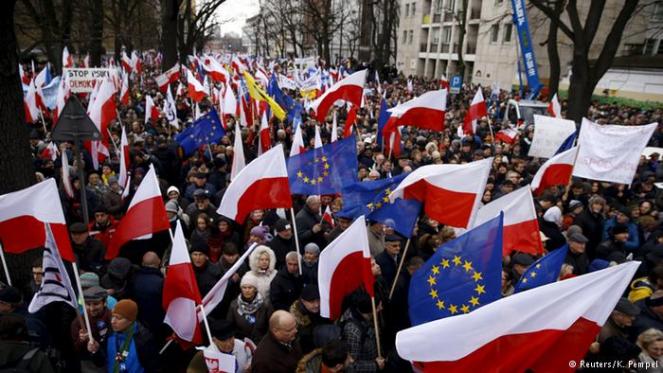
This separation of east from west represents fundamentally a mistrust, a fear in western Europe from western Europe (perhaps well founded) that our eastern European cousins are not willing to adhere to western European democracy. The situation in Hungary might legitimise this fear that the West didn’t completely win in 1989, however, Poland is different; it has a thriving parliamentary opposition, in the form of Nowoczesna (.N), Platforma Obywatelska (PO) and the Polskie Stronnictwo Ludowe (PSL) all challenging PiS in its actions in the Sejm and Senat. There is also the extra-parliamentary group, Komitet Obrony Demokracji (Committee for the Defence of Democracy, KOD), which has fought an active grass-roots campaign, protesting against PiS’ authoritarian legislation and calling for the people to challenge the shift to the right. With this, I say we can only support the Polish resistance to PiS actions, and not override it. Meanwhile, if we are going to criticise Polish undermining of democracy, we should also look to our own democracies and evaluate how effective they are as well; I think we will find they are not entirely perfect either.
Sources: FT, FAZ, The Guardian

