
Poland’s constitutional court, the Constitutional Tribunal (Trybunał Konstytucyjny, TK), ruled on Wednesday that the laws passed by the PiS controlled Polish parliament in December were unconstitutional, and should be repealed. The court’s judgement concerned not only the content of and perceived intentions of the laws – which included increasing the number of judges required to make a ruling and limiting the court to dealing with cases chronologically – but also the manner in which the laws were passed, being rushed through the Polish Sejm and Senat. The head of the TK, Andrzej Rzepliński, argued that the laws passed by Beata Szydło’s PiS government were intended to limit the actions and independence of the Tribunal, saying “In making it impossible for a constitutional body like the Constitutional Tribunal to properly function, as well as interfering in its independence and separation from other branches, violated the principles of a law-bound state.”
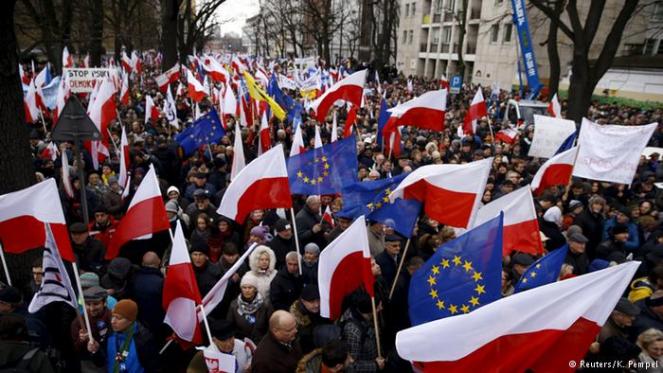
With these judgements, the constitutional crisis in Poland dramatically worsened, with two branches of government now taking opposite stances. In reaction to this, Prime Minister Szydło refused to publish the TK’s ruling, despite being obliged to constitutionally; the FT reports that in doing so, the Prime Minister rejected the Tribunal’s ruling. She argued on Wednesday that by making this judgement, they have violated the very laws they were judging on, and thus the judgement is invalid. Nevertheless, the refusal to publish the ruling has prompted opposition movements on Poland, including the former ruling party Platforma Obywatelska (PO), liberal opposition party Nowoczesna (.N) and the Komitet Obrony Demokracji (KOD, Committee for the Defence of Democracy) to launch demonstrations in Warsaw. Protests took place outside the Prime Minister’s Chancellery, demanding the official publishing of the Tribunal’s ruling. Rzeczpospolita reported that these groups brought a printed version of the Tribunal’s ruling and pinned it up on the Government Legislation Centre in the capital, meanwhile many others held up their own copies to stand alongside the Tribunal’s ruling, and projectors were used to display the ruling on the Chancellery walls. Leader of the KOD, Mateusz Kijowski, said at the demonstration “All those who have the good of the Polish people at heart are today at the Chancellery. We are deeply committed to the respect of the law by the lawfully elected government.” The FT reported that the opposition parties in Poland have begun to describe the rejection of the TK’s ruling as a coup d’état. .N leader Ryszard Petru said that “Not carrying out the verdict of the Tribunal will mean the most serious constitutional crisis in Poland.”
On Thursday Poland’s Ministers struck back at the TK’s ruling, with leading figures in the PiS government criticising the Tribunal’s actions. Foreign Minister, Witold Waszczykowski said “This is not a judgement, it’s a political position…Rzepliński increasingly reminds me of the Ayatollah of Iran.”According to the Foreign Minister, in Iran instead of democratically elected figures dominating the law, it is interpretation through jurisprudence. Meanwhile, Justice Minister Zbigniew Ziobro said “The decision doesn’t have any legal force and is not legally binding.”These are men who have compared EU oversight of Polish democracy to the Nazi occupation after 1939, and have suggested that the Polish press is no less free that the German one, despite replacing the managers and editors of the national broadcaster TVP with figures appointed by PiS. POLITICO Europe reported that the deputy Justice Minister likened the TK’s judgement to nothing more than a meeting over espresso and cakes, with no legal significance. Despite the political backlash, including the Prime Minister’s own denial of the validity of the verdict, the leader of the TK, Rzepliński, refused to accept that the laws were already in place, because in that case, the Tribunal would not be able to rule in their constitutionality. In a further attack on the Tribunals ruling, Justice Minister Ziobro ordered an investigation into the ‘leak’ of the Tribunals verdict, which without official publishing by the government, should not have been accessible to the population at large, reports Gazeta Wyborcza.
Meaning for the wider crisis in Poland
Just as about every commentator on the subject has said, this clearly represents a development in the Polish constitutional crisis, as now officials in an arm of the Polish government have come out against the PiS executive. From the rhetoric that has come from PiS leaders, and the actions they have taken, particularly in refusing to publish the judgement, we see further and more ominous willingness to break constitutional rules in order to achieve their aims. This may well lead to a further crackdown by PiS on their opponents, broadening their attack on the media to the private press perhaps, removing more judges they disagree with and passing more draconian laws. However with the Venice Commission to publish what will undoubtedly be a negative ruling on the Polish constitutional situation, and other international bodies including credit rating agencies responding negatively to Poland’s shift to the right, it seems internationally Poland can only become more and more isolated.
Nevertheless, I think these developments are a positive sign in the long run; because it shows Polish resistance and adherence to the liberal, European tradition has not been stamped out. Admittedly it seems that PiS has opted for a more passive means of dealing with domestic opposition, by apparently not even engaging KOD or the opposition with regards to the current issues, whether civilly or otherwise. However, the fact that liberal opposition has not died in Poland, people are still willing to take to the streets as members of the KOD and demonstrate, and further still, Poland’s judiciary is not going to just lie down and accept its emasculation are signs we can only take as positive. Ultimately that is how a democracy confronts its opponents; through civil disobedience, protest, campaign, grassroots opposition and adherence to the constitution; now the opposition in Poland can clearly state that what PiS is doing is unconstitutional and wrong. They could even go as far as to say un-Polish, against the Polish people and a betrayal of the nation, however we’ll see what language comes from the KOD and others as this latest development continues to make a difference. Will this change PiS’ course? If you listened to Jarosław Kaczyński, apparently not. However I think from the intense backlash the Ministers have given to this ruling, it is pretty clear they are concerned. I doubt they expected this much backlash to their plan to Orbánise Poland, neither domestically nor internationally. Both now are required to keep putting up resistance, for it to survive. Why did Orbán succeed in Hungary? Because we let him. The same cannot happen with Poland; the Polish people have to stop their government, but we must show them that Europe cares for the state of Polish democracy and civil rights.
Sources: FAZ, FT, POLITICO Europe, Rzeczpospolita, Gazeta Wyborcza, Süddeutsche Zeitung

