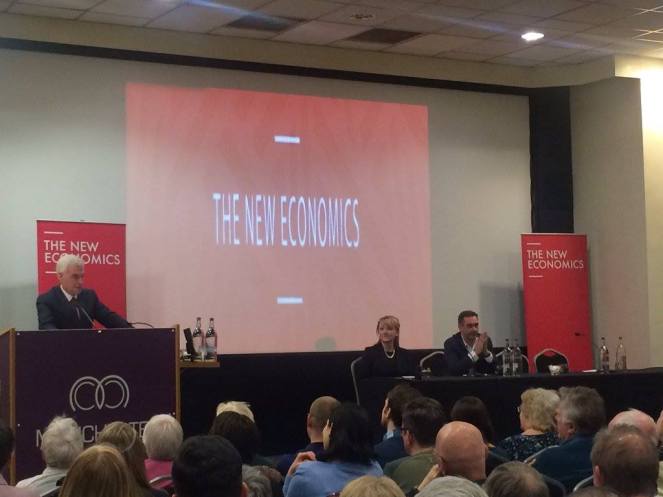
On Wednesday I had the pleasure of travelling to Manchester to attend one of John Mcdonnell’s ‘New Economics’ lectures. Paul Mason, economics journalist and columnist for The Guardian, gave a speech about policies and strategies that the Labour Party can and should adopt for when it heads into the next election. In fact, on more than one occasion he encouraged Labour to begin pushing for them even whilst in opposition (which is more useful than it may seem). I’ll be honest, from what I heard, combined with the sorts of ideas coming from other commentators and academics in a field which, as Yanis Varoufakis has said, has for a long while now produced nothing of consequence, intellectual weight or political usefulness, this was encouraging. In other words, what I heard on Wednesday evening in Manchester, and the kind of economic ideas that John Mcdonnell, Jeremy Corbyn and their European allies (Mariana Mazzucato, Yanis Varoufakis, Thomas Piketty) are trying to spread with their New Economics lectures are truly revolutionary. A report of the evening and my own analysis.
Some of you may have noticed that despite being British, spending the majority of the time in London and being thoroughly engaged in politics, I don’t speak often about exclusively British politics (except for the EU referendum). And I’ll be honest with you, I had lost some faith with British politics. Especially after the elections last year, where the Conservatives won but what was made to seem like a landslide only because Labour performed so incredibly badly, giving the Tories an intensely slim majority in the Commons, I felt like we were entering 5 years of British politics in which there would be almost nothing to look forward to. Even when failures in our system challenge the Tories as opposed to support them, they come up with bad answers. The House of Lords effectively rejected Chancellor George Osborne’s plan to scrap tax credits last year, and what was the Prime Minister’s response? Stacking the Lords with even more Conservative peers. To say I’ve been underwhelmed is to put it lightly.
However, what was also clearly noticeable, is that the answer to the economic challenges of the post-2008 world were not coming from Britain, but from our continental brothers – Piketty in France, Varoufakis in Greece. The kind of revolutionary economics they were discussing and advocating for found no resonance among the British political class. Or so I thought. My estimations have completely changed with Paul Mason’s lecture on Wednesday.
John Mcdonnell spoke first and made it clear from the beginning his intentions with the ‘New Economics’ lecture series. Labour had lost the last election quite badly, and as reports have made clear, besides Ed Miliband, Labour’s problem was a lack of credibility on economics. So, post-May 2015, and the Corbynite victory in the Labour leadership race, the new leadership chose to correct that troubling issue, and provide Labour with some intellectual economic backbone again. Now here, some of us may get concerned. Tony Blair also attempted to correct the public’s perception of Labour’s grasp on economics, and what did we get? Blair joined the Social Democratic retreat from left-wing economics which we saw across our continent, notably in Germany with the Hartz Reforms. However, Blairite lurches to the right are not on Mcdonnell’s agenda. The Labour Party are aiming for a different kind of change in perceptions, which critically hinges on a shift in the entire economic debate in this country. From the belt-tightening, austerity drivel that the Tories have religiously spoon-fed the British population since 2010 (as Mcdonnell put it, reducing the economic debate in this country to a facile level), the Labour Party wants a coalition of unquestionable economic minds (Varoufakis, Mazzucato and Piketty as well as the likes of Joseph Stiglitz) to support them in calling for radical economic changes which are geared towards a sustainable, stable, green and crucially equal level of growth across British society, with the aim of reducing the inequality chasm and ending the neoliberal assault on civilised society.
So, onto Paul Mason’s speech. What was so fascinating frankly was the number of ideas and concepts which not only are not talked about in modern economics, not only would be rejected by those considered ‘experts’ but in all honesty would be considered blasphemy by the neoliberal establishment that has been fortified since the 1980s. Among the most radical suggestions were the replacement of an appointed Governor of the Bank of England with an elected official, and the write-off of the national debt. But don’t let this deter you (and it shouldn’t, because there are arguments to be made for both suggestions), because at the heart of Mr Mason’s argument was a 4-pillar plan for Labour’s economic revolution: expansionary fiscal policy, radically innovative monetary policy, industrial policy and structural reforms (though not the kind you’d here from the IMF).
Firstly, fiscal policy. For those unsure, fiscal policy is the government actively spending and collecting money – spending on the welfare state, education, investments of its own into for example infrastructure, and the raising of cash through taxation and borrowing. Now naturally this the first point of entry for any left-winger, because spending on infrastructure, a reinforcing if not expansion of the welfare state, and more government involvement in the economy are all well-trodden paths. Mason of course highlighted to those of the audience who seemed to have never heard of this that to the Conservatives, fiscal policy is about how much of the state can be rolled back, expansion under no circumstances should ever be considered, and really the word “fiscal” should be consigned to the broom cupboard until it comes time to snap another piece off. However, there were two other crucial (though not necessarily revolutionary) points Mason made here. Firstly, that sometimes a lowering of taxes is necessary in order to allow the economy to grow, and to flourish. Taxes are a tool of the state like any other and if it so happens that reducing them in certain areas may stimulate economic activity then Labour has to be prepared to do that. Secondly, Mason spoke of a basic income; that’s not a minimum wage, or even a living wage, but a basic income, under which it doesn’t matter who you are, which part of the country you come from, your aspirations or education, old, young, disabled or not, you have a basic, non-means-tested income guaranteed to you as a right and provided by the state. That was as Mason correctly pointed out an underlying assumption of the Beveridge Report in 1942, which was the intellectual foundation for the post-war Labour government’s welfare state, at the centre of which was the NHS. In that same report, William Beveridge made the argument that its not about reducing incentives, but providing an acceptable minimum – a platform from which people can go out and provide more than that minimum for themself and their family. It’s time to move away from the idea that people need to pull themselves up by their own bootstraps; in a modern civilised society, you are guaranteed a certain quality of life no matter who you are.
Next we move onto monetary policy; the government policy which influences the money supply and the cost of money (interest rates); monetary policy is under the control of the central bank. Now, it’s perhaps in this policy area that we heard some of the most creative, innovative, radical and I’d say inspiring words of the evening. I already mentioned the fact that Mason wants the Governor of the Central Bank to be elected, but this ties in to his (and his colleagues) view of the Bank and monetary policy in general. Firstly, that a lot more can be done with monetary policy than people think, and secondly, it is a fully-fledged and valid arm of the government, should work in concert with the Treasury’s fiscal policy, and that there’s no reason to believe it should be independent of democratic control. Mason initially demonstrated with the experience of the Labour Party in the early 30s, with the rising costs of the Great Depression and the resulting austerity proving more and more difficult to stomach for labour politicians, the wonders that the policy could achieve. However more crucially for today, what could this mean?
Firstly, Quantitative Easing (QE, the effective printing of money through the buying up by the central bank of other banks’ debt) needs to be redirected away from the debt which simply inflates house prices and into areas of the economy which desperately needs more investment, such as green energy. By directing QE into buying debt used to invest into green technology, other start-ups, modern tech companies and so on, huge amounts of cash could flow into the starved sectors of the economy that banks have been unwilling to invest in since 2008. For the citizen, what could this mean? Well, how about those of us with student loan debt, having successfully completed our degrees, and taken on the financial risk of getting a loan in order for further education and self-improvement, finish our studies by receiving a note from the central bank telling us our debt has been bought up, and we no longer have the future burden of having to pay it off? How about those of us who have that entrepreneurial spirit get supported by a loan from the government in order to start up our firm (such as Apple was). What does this have to do with monetary policy? Well, the sheer level of QE in Britain has put the cost of money so low that interest rates for the government are almost 0 – perhaps they should use this opportunity to borrow and flood that money into the private sector. And yes, we will hear the Conservatives saying “Are you mad? The risk of inflation would be enormous! How is the Bank supposed to keep to its inflation target (currently 2%)?” Well, Mason had two answers to that challenge; first – what inflation? We are looking at inflation rates of about 0 at the current time. The second answer is – perhaps the inflation target should be raised? 4% for example would allow for the Central Bank not to act so timidly when carrying out monetary stimulus, and means it could do what Mason argued from the start – for monetary policy to act in concert with fiscal policy (just as the central bankers and IMF are arguing they should do right now) and bring the full might of the government to bear in stimulating economic growth. And it is in the light of these arguments, and of admitting to ourselves that separating the Central Bank from the government really has been an elaborate neoliberal deception, that Mason believes the Governor of the central bank should be elected. Only under democratic control, could the governor be directed in the necessary ways to truly bring fiscal and monetary policy into line, and prove to the rapidly-losing-faith British population (of the North in particular) that the government is willing to do whatever it takes in order to make the economy work for the British people again.
The last two areas of policy were the least fleshed out. By industrial policy, Mason means directing the private sector (though not planning it) in order to achieve certain economic targets. How this would take place, that’s still to be debated (though their was a short reference to the Wilson governments National Economic Development Council, and about how it could have been used more effectively. Consider also John Mcdonnell’s intention to reduce the role of the Treasury in economic affairs, to the point there it and the Chancellor have their hand in every department and area of government). Finally, the Masonian structural reforms. Well, true to form, by this he means the complete opposite of what neoliberals mean. Trade Unions need to be strengthened again, workers’ rights to organise need to be protected, job security needs to be buffed and the organisation of firms needs to be radically rethought, so that they are democratised. Why? So that workers actually are able to see and experience the benefits of their increases in productivity, in putting in more hours, and crucially, reinvest those rewards back into the economy.
Now, I promised analysis, and of course any real analysis of economics needs to be critical. John Mcdonnell made the point at the start of the evening that everything Labour plans to do in the next few years will be reviewed and tested over and over again, from the Bank of England to the Treasury to all the policies they intend to put in their manifesto. And of course we may run into problems. Briefly looking at the proposals, issues could be found. There’s a reason why a democratic Central Bank governor might be considered crazy – how do you ensure that position is not abused for purely party-political ends, as the British system is prone to. What are the safeguards, checks & balances around that? What do you do with all this money that we have flooded into a system when we are not in a time of crisis to prevent inflation of the uncontrollable sort? Ultimately, there’s the old Conservative argument that intervention into the economy at the macro-level is unpredictable and unintended consequences are almost guaranteed. Not that this should be a reason to not intervene, but my personal question would be is how does a Labour government defend itself in such a situation? “We didn’t see that coming” isn’t going to be good enough for many, especially if it damages their economic situation.
However the real analysis for now is, what are these sorts of discussions going to do to the political, economic debate in Britain? Hopefully, as Mcdonnell and Corbyn want, it will completely restart it. Mason and Mcdonnell on Wednesday made the point that they want to Labour to argue these points and calling for them from the opposition. Another innovation came from someone in London asking during a different discussion “what’s PPE, and why have all these politicians done it?” From this, we got People’s Politics and Economics, where people who know the stuff go into communities who do not know all the details and get taught economics. Yanis Varoufakis gave a lesson recently in east London, according to Mcdonnell. If you want to send a shock-wave through the political debate in this country, this is how you do it. You give people the tools to begin thinking and analysing the issues themselves, and you get a discussion going. Why? Because the only people who are doing the talking right now are content to keep cutting away at state-spending, and allow the sick beast that is post-2008 capitalism limp on. Income inequality is greater than at any other time in history, to the point where the income gap has as I said become a chasm. In fact, social mobility in the west today should be referred to as the bridge of Khazad-dûm for the chasm those of us luck enough to be socially mobile have to cross, and the level of traffic allowed across that bridge.
The eagle-eyed reader may have noticed that the New Economics is the category under which this article has been filed. A tectonic shift in the way our country and our continent discusses economic problems, and the fact that we need to actually take part in rewriting the rulebook in redeploying our economies to serve the entire population (we’ll settle for the vast majority) needs to be brought to as wide an audience as possible. So I intend to cover more of this, both as it plays out and spreads in Britain, and the rest of Europe. Why? It’s the same reason that I have a profound belief in the importance of the press and free media – because how does anyone start a revolution? You get people talking. As Beveridge wrote in his report over 70 years ago, “a revolutionary moment in the world’s history is a time for revolutions, not for patching”.