
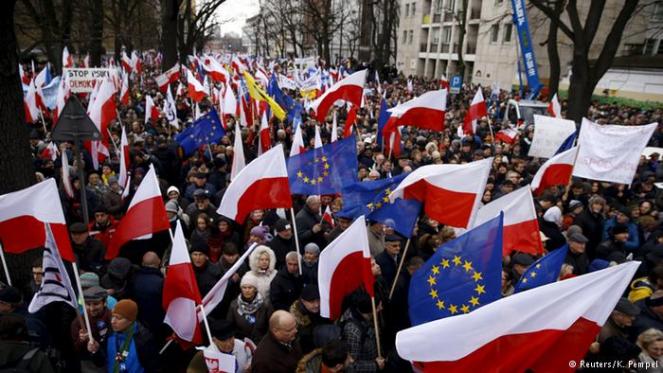
The PiS government in Warsaw’s assault on liberal democracy has been raging for over a year now, and, while much of Europe has turned its attention away to other news, the fight goes on to stop Poland from taking the same road as neighbouring Hungary. Recently, over the Christmas period, several demonstrations have taken place outside the Sejm building in Warsaw (the Polish Parliament) by the Komitet Obrony Demokracji (KOD), and the opposition held a sit in of the parliamentary chamber. This led to the unfortunate prompting of the government benches to convene a vote on the 2017 budget in another room, through a chaotic show of hands. Even with Poland’s liberal democratic institutions embattled, they have not been toppled.
Even if most of us are focussing on depressing news closer to home, Timothy Garton Ash recently wrote an article in The Guardian with his most recent thoughts on one of Europe’s several spiralling crises. I agree with much that he says, and can only defer to him in areas where his expertise is far greater than mine. Garton Ash spent much of the 1990s criss-crossing Poland as well as others parts of Eastern Europe, preparing the way and drumming up support for accession to the European Union. He points out that Poland has a history weak opposition politicians, and a democratic history of 27 years. This combined with Jarosław Kaczyński’s distinct brand of populism has made of mockery of Poland’s institutions and has shown them to be rather weaker than many had hoped. Now, the greatest bulwark which stands in the way of Kaczyński turning Poland into a second Hungary is the Committee for the Defence of Democracy, KOD. Whilst Poland’s political class have not been democratised then, the Polish people have shown themselves to have become an active and engaged civil society, a true dêmos of their democracy.
I have two main bones to pick with Garton Ash over his article however. Firstly, his treatment of Poland’s democracy given its 27-year history is a little of the mark. His assertion is that, with 27 years of democratic government behind them, Poland’s institutions should have learned to protect themselves from this kind of populist wave. I disagree. For the life of a democratic state and its institutions, just shy of 3 decades is near nothing, especially with centuries of autocratic government and foreign occupation ingrained in the essence of its politics. Garton Ash cites Germany as an example to be followed by the Poles; 27 years of experience with democracy would put Germany in 1972, a time at which the institutions of the Federal Republic were far from being overwhelmed by a demagogue like Kaczyński, or Orbán.
However, this is to misread European history. For democracy in Europe has been a much longer battle than simply the post-war era, Germany beginning in 1949, and Poland beginning in 1989. If we take the historical view, we see just how short Poland’s story with democratic government has been. For example, France took just over 90 years to establish a system of stable democratic institutions, beginning with the revolution in 1789, and finishing with the establishment of the Third Republic in 1871. Throughout this time, France saw terror, violence, dictatorial regimes and popular revolt. Twice before 1871, republics established by the French liberals collapsed into authoritarian regimes. Spain has also had a similarly difficult relationship with creating lasting democratic governments – some would say they are still trying to cast off the last vestiges of the last authoritarian regime to plague that land. The First Spanish Republic was established in 1873, though the fight for democracy in Spain no doubt began long before that, with the beginning of the Carlist Wars earlier in the 19th Century. Stable democratic institutions were only established in 1978, at the end Franco regime. Even Germany, Garton Ash’s chosen example, and for many the poster-child of liberal democratisation, has a well-known fraught relationship with democracy. We can trace the beginning of Germany’s fight for a more democratic Germany to the 1848 Revolution, when constitutions were established in previously autocratic German regimes. However, Germany had long to wait, until the catastrophe of the First World War, before the first German republic was proclaimed in Weimar, 1919. With the descent again into dictatorship in 1933, and the occupation from 1945, it would be another 30 years before democracy gained a firm foothold in German society.
So, it’s clear that Germany needed more than a paltry 27 years before it had a stable liberal democracy. No country in Western Europe had such a luxury. If you trace the British development, we can see centuries were required for a proper democratic government to be established. But it is not this misreading of history that bothers me most, so much as Garton Ash’s attitude towards popular mobilisation and the role of the dêmos in democracy, the role of normally private citizens. “Such a popular mobilisation should not be necessary in a 27-year-old parliamentary democracy”, followed by “you don’t need a Committee for the Defence of Democracy. Liberal democracy is designed to have its own inbuilt defences”, are some fairly troubling comments from one of Europe’s leading intellectuals. The idea that democratic institutions should be able to defend themselves without the dêmos, to me, seems to undermine the whole point of democracy. Not that I misunderstand his point; there should be an institutional mind-set which resists men like Kaczyński and there should be checks built into the constitution which limit the ability of politicians to tear down the liberal order in a country. However, Poland’s institutions were protected by constitutional checks and balances. The fact is, a constitution is not enough to defend democracy all by its own.
What protects a government from the predatory demagogues is not the strength of its institutions, but the strength of democratic feeling in society. This is developed in several ways, and age is a contributing factor. Hence the slow but fairly stable arrival of British democracy – Westminster had established its authority long before it became a truly democratic institution. However, there are other elements at play. For example, Poland still has an abundance of strong-men, who are willing to tear down institutions, rather than wield them, to get what they want. Why have were the battles for democracy so drawn out in other European states? Because of this precise reason; the strong men of 19th Century Western Europe were willing, rather than to embrace democratic institutions, rip them to shreds in violence, bloodshed and reactionary retribution. Why was this the case? It comes back, fundamentally, to the dêmos. Poland may have a political-class still unwilling to wield their institutions, but it also has a strong, democratically-minded civil society capable of defending the freedom and justice they’ve won, and this is the most crucial key which Garton Ash misses. Politicians are mainly of a mind of winning power and retaining it; they must believe that they can do this better through democratic institutions rather than destroying them, and the deciding factor here is if the people believe in and are willing to defend their democracy, or if they are not. France 1805, with the crowning of Napoleon, did not have a democratic civil society. Nor Spain 1876, Italy 1924, or Germany in 1933. Germany’s people were convinced of the failure of authoritarianism more than the successes of democracy in 1949, because of the annihilation of the German state and people after 1945. France had a similarly painful moment in 1871.
The British example is telling again in this instance; Britain’s true revolution lasted from 1642-1649, with the English Civil Wars. The republic which was established thereafter did not last long, however its fall was not followed by authoritarianism that one might expect. To the point that the Westminster Parliament was able to depose James II of the restored monarchy in 1688 during the Glorious Revolution. Why was this last act of the English Civil Wars possible? Because Britain’s rulers knew that the civil society had been established just enough to put the power of the people behind them, and not the monarch. Enough Britons believed in their liberties to empower the defenders of them to act when the opportunity arose. By contrast, the German people did not believe in their own democracy in 1933. Poland’s political class are learning this lesson today; they may still be willing to use authoritarianism, however Poles are not. This is the source of democracy, not the shininess of the institutions which are set up as a result. Garton Ash may know this, but the tone which he uses towards the protests which have taken place against the government in Warsaw suggests otherwise. He is right that only Poland can answer the question of Polish democracy. However, this answer must come from the dêmos, not the supposed robustness of institutions.
Sources: The Guardian

