
The institution of the pub persists at the heart of British life, fulfilling an undeniable and necessary social role. The exercise of going for a drink at the pub is something we all grow up with here, even if you do not partake yourself – reading about it, watching it on the tele, hearing about pub-related stories from other people and seeing the life it fuels on nights in towns and cities across these islands. For someone who grew up in this country, it’s hard to imagine social life without a venue like the pub, as malleable a setting as it is. Having lived for some time outside of England, I’ve been prompted to reflect on what that means and the place of the pub in everyday life.
In Berlin nichts Neues
For the best part of the last 11 months, the setting for my Erasmus year at the Humboldt and hence my place of residence has been die Hauptstadt, Berlin. I’ve had what some might call mixed luck with the city. As friends never fail to tell me, I did not have the best of success with where I was living – a quiet borough in south-east Berlin about an hour from anywhere of interest in the city (except the airport, about 10 minutes away, and my favourite place in the world, Altstadt Köpenick). The winter was exceptionally cold, and the year I’m in Berlin for the world cup, Germany finishes bottom of the group and don’t even make it to the round of 16. On the other hand, the summer has been beautifully sunny and warm, and the experience at the Universität and my temporary home have been an eyeopening and enjoyable one.
While some of Berlin hasn’t struck me as too dissimilar from other north-European cities I’ve visited, there are differences which remain stubborn in their persistent, noticeable unfamiliarity. One thing I noticed when first visiting Berlin was the comparative quietness of the city, in pin the centre at least, when considering their equivalents in London or Paris. That was in April 2014 – something about the intensity of bustle and animation you see in London seemed dampened or tempered; by nightfall, in Berlin Mitte, things had become distinctly less alive. Again, in January this year, when my parents visited, we were looking for a restaurant to have dinner and they kept asking me where everyone was. Their main reference being London – the centre of which never really reaching a point you would describe as quiet – Berlin seemed comparatively empty.
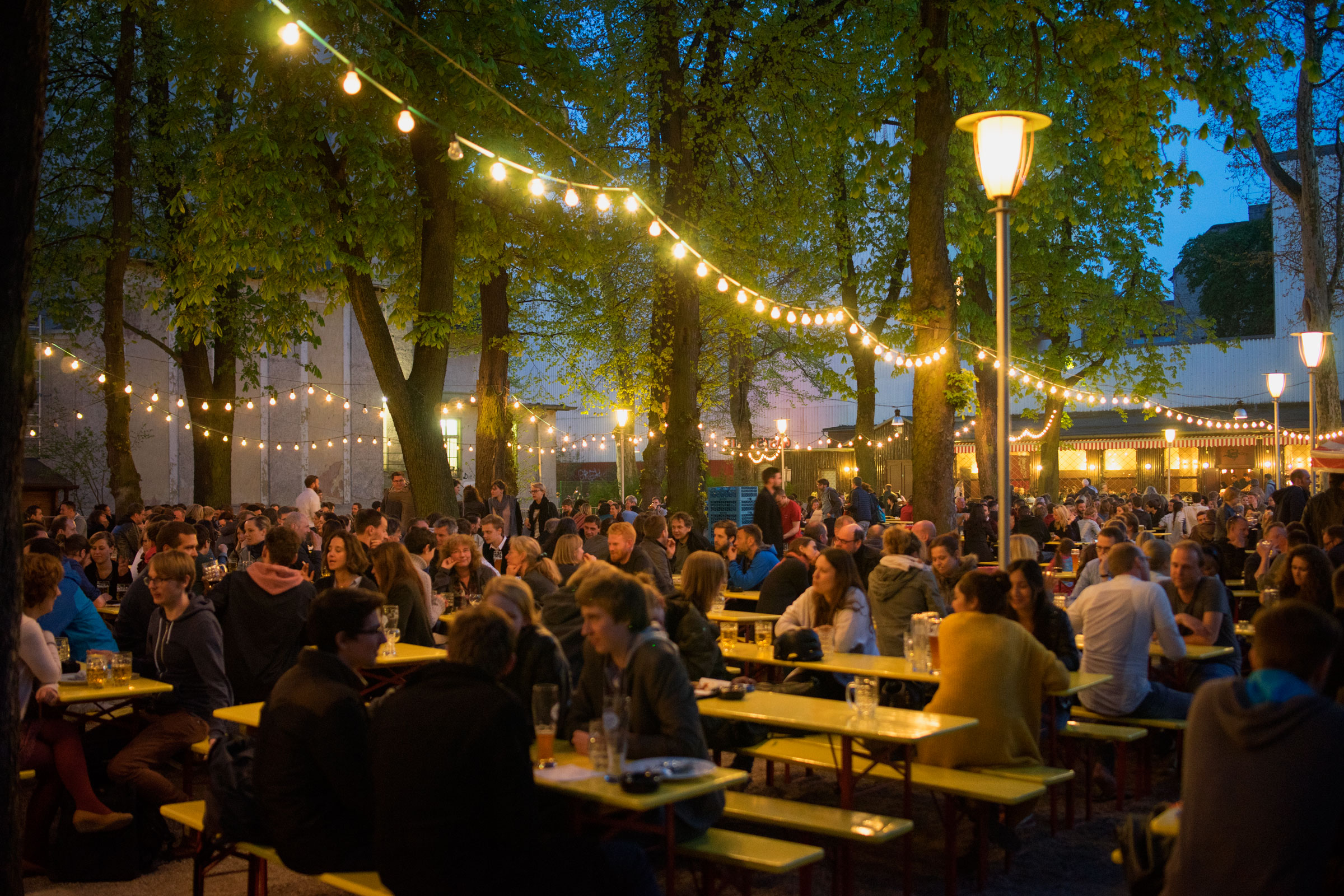
Several reasons explain this, the population density for example is notably lower in Berlin. The temperature is another one. The winters here are colder than in London; likewise the summers are warmer. This gives rise to an astonishing transformation in the city’s appearance and spirit as spring grows into summer. The Berliners, who a couple of months previous were zealous in their desire to be inside and pursue their outdoor existence as timely and efficient a manner as possible, now take any opportunity to casually stroll through the sun-drenched streets, relax on the terraces of cafés and restaurants and turn up en masse at beer gardens. It is the weather that facilitates this change much more here than in London, even though this very clearly happens there as well, as this is not merely a change in circumstance but seemingly the very spirit and energy, the Weltanschauung, of the population, seems to metamorphose from the inexorable industry of the grey North to a kind of joie de vivre of the Mediterranean South. The social architecture of the city is built around this: beer gardens, patios and terraces are made not for the winter; parasols, and not parapluies, are the umbrellas you will see. And this effects the nature of social drinking.
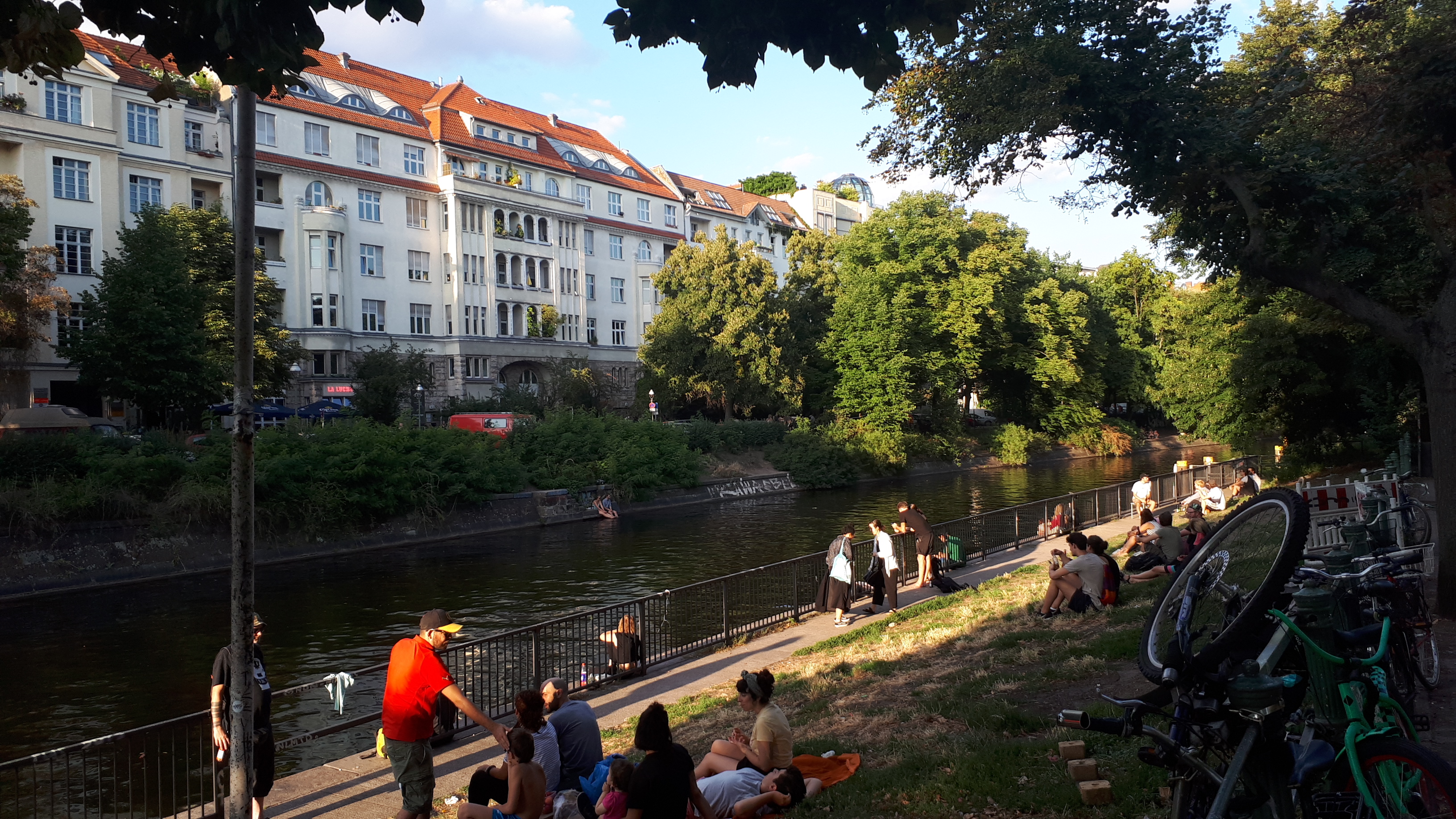
For the past months of living in Berlin I’ve tried to put my finger on what exactly the source of this curious state of affairs is; the unfamiliar reticent silence of the winter, replaced in the summer by a previously unknown vitality, a change of state with all the transformational power of a resurrection. I think I’ve found one part of it, one part that makes it so noticeable for me: there are no pubs – or at least, no pub culture.
The place of the pub in British life remains for me, despite everything, undeniable. It occupies a central position alongside tea, the BBC, roast dinner and the monarchy. Not to say that any of these things hold the same significance for everyone in Britain; only that, everyone is aware of the heights they command and have commanded in British life. You cannot make reference to any of them without their looming cultural presence overshadowing your own perspective. However, the reason for this kind of presence the pub has, the basic itch that people have drawing them to the pub, is of course not unique to Britain.
Going down the pub
I was reading Der Nasse Fisch recently; in English, Babylon Berlin, adapted into a brilliant TV drama of the same name by Sky and ARD last year. The story follows Kriminalkommissar (Detective Inspector) Gereon Rath, who is transferred from his native Cologne to Berlin during the period of the Weimar Republic’s Golden Twenties, as they near their end in 1929. There is a moment when Herr Rath finds himself with the irresistible urge to go out for a drink when presented with the prospect of another night in with his landlady and her tea and rum; to that end, he heads to Kakadu on Ku’damm in search of an evening with far less predictability. We’ve all been here I think, as the idea germinates in a field of several previous inconsequential or otherwise tiresome evenings; creeping slowly out of the shadows, across from the back of your mind until it presents itself front and centre and we reach the crescendo-moment of realisation: no, not tonight. Tonight I’m going out.
Initially just an itch, pubs feature prominently in the context of this feeling in British culture: The Garrison in Peaky Blinders; The Nag’s Head in Only Fools and Horses; even The Queen Victoria from Eastenders. The song “Hurry up Harry” by Sham69 demonstrates the feeling quite succinctly. ‘Let’s go out right now‘. Who knows what could happen, who knows where we’ll end up or who we’ll meet or whether we’ll even have fun; it’s in uncertainty that the spirit of adventure bursts into life, a big bang exploding seemingly into a universe of possibility. Not knowing what the night will bring, except that could be anything. It begins as little more than an itch, an itch that is universal, with responses to it is as diverse as are humans. I will focus for now on just Britain and Germany.
If we take Britain first: the ‘Public House’ (pub), an umbrella term for what once were referred to as taverns and inns, is an inescapable fixture of social life. I want to take a moment first to clearly define the boundary between pub and bar, which is central to the discussion. Bars have much more specific, rather than casual, purpose. You are likely to go to them as part of a more intentional, planned night out (out-out, as the saying goes). You’ll find yourself at a bar likely having planned with your friends earlier in the week with something along the lines of ‘wanna to go out Friday night?’. You might have a specific bar in mind, for its particular atmosphere or music or drinks range. I can’t prove this but bars often feel smaller, compared to restaurants or indeed pubs, something about exclusivity. On the streets of Prenzlauer Berg, a distinctly Berlin flavour of this hipster-vibe permeates the air; intermixed with off-licenses and Vietnamese restaurants, there are these small, niche settings around every corner. One or two taps for pils, craft beer and spirits filling the rest of the shelves. Clientele are mostly younger, not necessarily staying until close and certainly arriving before 20:00 (some bars are not even open yet).
The pub on the other hand is very different. It is a jack-of-all-trades, it may be open all hours, there for a casual drink or a whole night of adventure. From a functional perspective, this explains why the pub has been so central to social life in Britain, and furthermore, why it is exactly the right response to the itch. At the best of times, that promise of adventure exudes from a pub; it’s billowing from the chimney and fills the very air of the inside with the magic of uncertainty. It’s why that brilliant phrase is so exciting, hanging on the cusp of certainty and anticipation: “we’ll just go for one”. Just a swift one. We all take part in the dance, in the fiction, perfectly aware that it never has been and hence won’t be just one.
And yet, we have no idea what the night will be. Because you don’t always know who you’ll meet in a pub, because everyone is invited. You don’t know what tone or shade the atmosphere will take. This is why I love the pub. All-comers are welcome: you want to stay until close, you’re welcome; you want dinner, you’re welcome; you want to stop in after work, you’re welcome; you want to come in early on a Sunday, under the guise of Sunday Lunch – indeed, you are welcome. The pub was and remains a universal institution in an age of society fragmented into a series of different scenes and trends; you will see the whole manifest patchwork of a people through the varifocal lens of a pub in Britain.
Now we take Germany. For previously stated reasons, we won’t be considering bars here. They just don’t cut the mustard. They appeal to niches, serve parts of specific scenes and distinct images. Ideal to be isolated from everyone else by post-modernism like bubbles and echo-chambers. So what else is on offer? The ‘Gaststätte’ or ‘Gasthaus’ is roughly equivalent to an inn – as in, offering alcohol, meals and overnight accommodation. This became a pub in Britain – in Germany, it became a ‘Kneipe’.
Indeed, they look, smell and sound very much like pubs. A Kneipe has regulars, and will likely be open most of the day. They also have offerings of classic German gutbürgerliches fodder. But this is where the similarities end. Kneipen are almost always small and confined – in fact the word Kneipe comes from the idea that people found themselves pressed close together when drinking in one. Likewise, there’s not the same range of choice as in a good pub. These are small deviations. There are two major differences however. One is the lack of inclusivity. From my experience, Kneipen are mainly for locals. People who have lived and worked in a place for a long time having probably been born there.
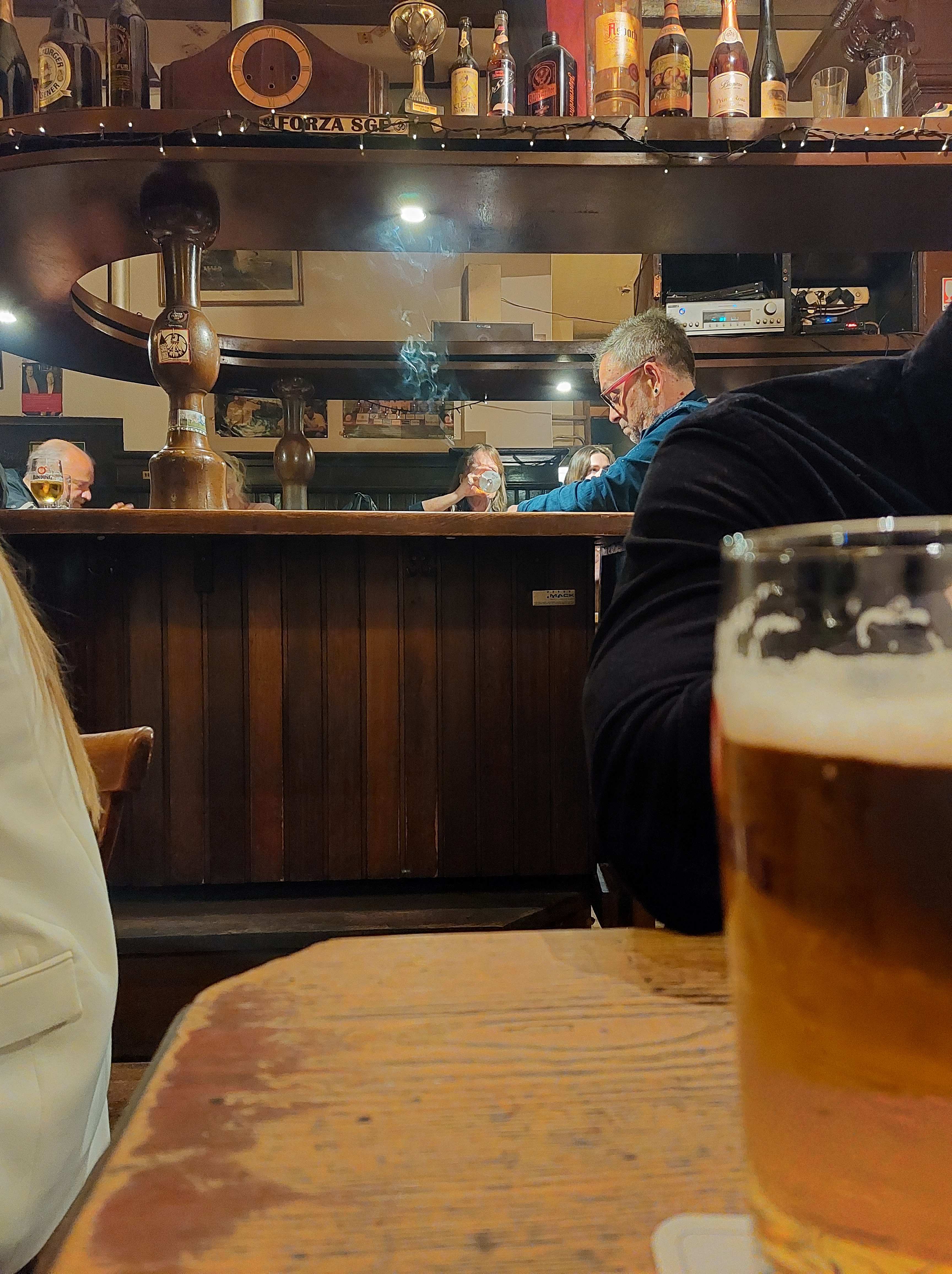
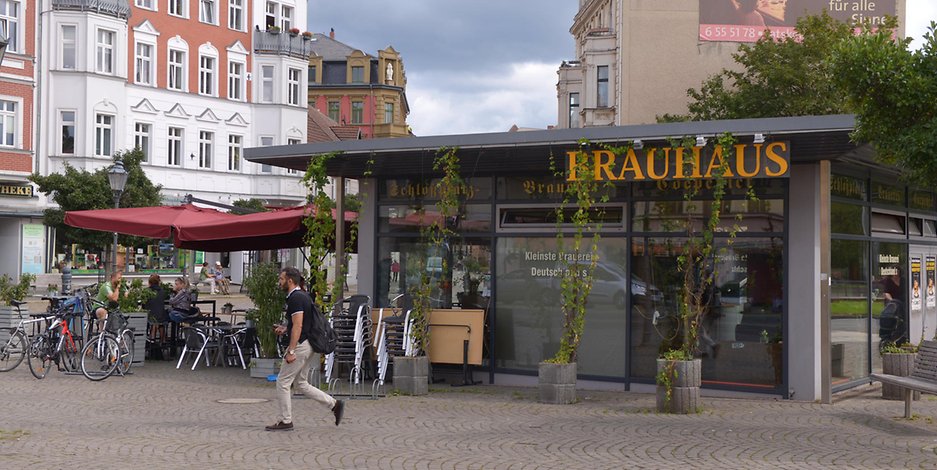
In Berlin at least, one feels they are entering someone else’s territory when entering a Kneipe. You sometimes encounter this in Britain of course. I was in the Highwaymann in Skegness once, and it was mainly the fact I was with my father and that it was his Dad’s local when he lived there that I didn’t immediately decide I’d made a mistake. But Skegness is a small town on the Lincolnshire coast, and newcomers to the town in general are not exactly going to receive the warmest welcome. Often pubs try to avoid this. Usually there are enough people in them in any case so that you don’t feel conspicuous as a newcomer. The Schlossplatzbrauerei in Köpenick is one of the few Kniepen that also succeed at this.
There’s the second major difference: Kneipen are no longer popular. You feel conspicuous entering a Kneipe because you are immediately noticed when you enter by the few patrons inside none of whom are under 40. They have lost the Germans’ collective imagination, which is the worst fate that could befall them. Imagination is the first thing a pub should grab. Imagination of adventure. It has to be able to make you think: the journey could start here. Not that it’ll go anywhere, or even start at all. Just that it could. It has to have the air of a knock on your door by a mysterious old wizard. For this reason, they are dying, with the number falling by over 20% in the last 10 years.
What else then? My next suggestion isn’t necessarily something that comes immediately to mind when thinking of pubs. The humble ‘Späti’ (Spätverkaufsstelle) looks like a cornershop or offlicense. Where it differs from an offlicense, so-named because you are not allowed to drink on-site, and what brings it into contention, is that you are allowed to drink at the Späti, and the Spätis cater for this. Mainly an East German phenomenon – there are some 900 in Berlin alone – a Späti has two advantages of being cheap and ubiquitous. You will almost certainly go past one on your way home. If anyone ever does actually have a swift one, this is where it happens. It is that knowledge that takes the magic out of them of course; the adventure will certainly end after a couple of drinks and perhaps a frustrated phone call asking where you are.
Lastly, there’s the Biergarten. The biergarten of course is entrenched our own cultural perception of Germany and a perhaps stereotypical image of the country. ‘Dirndl-clad maidens in the foothills of the Bavarian Alps carrying a physics-defying number of Maßkrugs of beer between tables brimming with rowdy-Germans at Oktoberfest’ is not an unrecognisable image associated with the biergarten. Of course, the concept exists all over Europe now, in various forms. Likewise in Germany, they do not all conform to this image; in fact, biergartens and their associated beerhalls probably come closest to what a pub is. Open venues which attract all sorts of people, whether old, young, locals or visitors, heavy or casual drinkers. They serve beer, food and nibbles; sometimes there’s live music; and the beerhalls are overwhelmingly wood-bedecked, old, comfortable and friendly.
The atmosphere is the closest I’ve found to that which pervades a pub. Public houses, establishments for all-comers to socialise, the beer facilitating the mystical process of merry-making between human beings. The ‘hallowed meeting places of all mankind’. Prater, also in Prenzlauer Berg, is a good example. But there is an unfortunate difference between the biergarten and the pub. Whilst I was able to enjoy myself at Prater on a rainy evening in October, from what I’ve seen the Berliners themselves see biergartens as much more for the warmer days of spring and summer (don’t let Oktoberfest fool you, it’s practiced neither by the Berliners, nor in October). The difference in the number of patrons between October and May is quite amazing. The spirit of the place noticeably improves. Berlin’s resurrection comes with that of its biergartens.
Plenty of beer, good beer, and cheap beer
So there you have it – none of these options manages to meet the all-comers, all-times, all-weathers benchmark of a pub. This comes as some of a disappointment for me, an absence in German society – etwas fehlt. That could be my own cultural context speaking; it seems normal to me to expect a public drinking forum available no matter who you are, where you’re from, what your purpose or what time of the year it is. Perhaps it isn’t normal for alcohol to be so readily available at all times of the day, all days of the year. The English in particular have the stereotype of drunkenness – the lager lout stumbling through the streets of Bermondsey-type thing.
In fact, statistics from 2010 tell us Germany consumes more alcohol per capita than Britain (11.8 to 11.6 litres of pure alcohol per year). Germans consume much more beer than Britons (53.6% to 36.9% of all consumption), though less wine and spirits. This shouldn’t surprise us since alcohol is so much cheaper in Germany, being taxed based on the drink’s gravity (its density compared to water, indicating how much of the sugars have been fermented into alcohol). On a pint of pilsner you’d pay just 5c tax in Germany, compared to 61c (54p) in Britain. In fact, it’s a surprise they don’t drink more – or perhaps that Britons drink so much despite the cost of alcohol.
Potentially pub-related is that Britons’ record more instances of what the EU Commission defines as ‘excessive’ drinking – 5 pints of beer or equivalent in wine or spirits. While alcohol consumption has been falling in Germany (was projected to fall to 10 litres by 2015), it is on the rise in Britain (supposed to rise to 12 litres). The pub and the Kneipe are both on the decline and have been for decades, as a consequence of both countries’ drinking habits evolving. And yet there is some cultural force which has enabled the pub to retain some of its presence in Britain’s common cultural memory in a way the Kneipe has failed to.
A demonstration of this has been the rise of Wetherspoons in recent years. Beginning in 1979, the pub chain now runs 1,000 outlets across Britain and Ireland, running counter to the general trend of pub-decline. To be clear I thoroughly despise the company founder and chairman, Tim Martin, when it comes to his politics and recent decision to replace European products served in his pubs with British and Rest of the World ones, which categorically is a stupid decision. But despite his views on Britain’s place in Europe, his views on how to run a chain of pubs are, largely, correct. In an article Telegraph in 2012 he explained he deliberately chose to open early to serve breakfast, to serve tea and coffee throughout the day, and to promote real ale produced by micro-breweries alongside products from the mega enterprises.
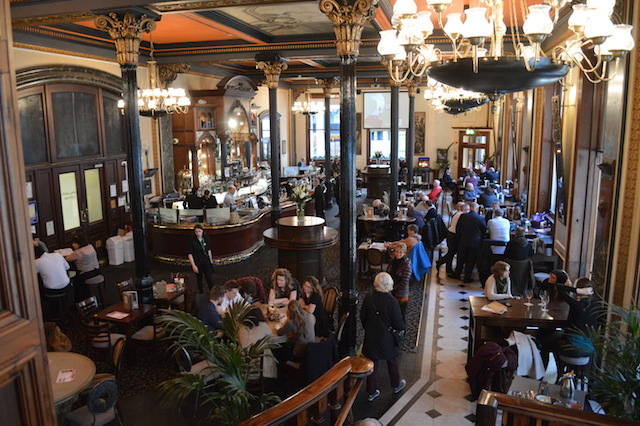
Martin, hence, understands the purpose of a pub – that is, to serve all purposes, like a home. A public home. Wetherspoons caters for the widest possible catchement of tastes, purposes and people – people who want breakfasts, who want dinners, who want cold drinks or hot drinks, who want local ale or continental lager. Does this mean his pubs lose character and uniqueness? Do they lose the personality that homegrown pubs would have? ‘They are soulless’, Will Self wrote in the New Statesman in 2013. Mum always says there’s no atmosphere in a Wetherspoons pub. I disagree and think this is missing the trick of a pub though, because, for all the efforts a publican can make to intentionally give their pub atmosphere (music, styling, themes etc.), it will not compare to the atmosphere created organically by a varied and multifarious patronage. That is what makes pubs special and that’s precisely what Wetherspoons has done its utmost to promote.
Of all mankind
It’s very much against the trend these days to be something as simple and universal as a pub. In the words of Iris Murdoch, they are like churches, the meeting places of all mankind. But like churches, they seem increasingly like artefacts preserved from another era. Imagine the state engaging today in the construction of anything as impressive and monumental as the Berliner Dom or St Paul’s Cathedral. The social context was different because it was simply assumed that everyone would accept the value of the state investing its wealth and power in building such immense testaments to the faith of the population in general (and let’s be honest, that no one could stop them).
The pub comes from an era when it was one of the few forums of socialisation, and hence the entire village or borough would turn up to them. This is the case no longer – but unlike churches they have managed to survive with some vitality into the post-modern era, as battered and weakened as they are. This is because people still believe in their universality to some degree. The pub still manages to be a wide swath of people’s public home. Alcohol only acts as the catalyst, initiating a process of human interaction that I think really can be described as magical. Think about it; between people who’s lives are completely unconnected, between events and experiences that have no relation to one another, moments separated by vast tracts of time, distance and perspective, bonds are formed between people who are so atomised today by our post-modern human condition. Our memories trigger the synapses in others’ brains which release more memories, and through that symbiotic process yet more memories are created, emotions triggered, emotions which bind in our minds with events, people, drinks, smells and which will be recalled in the future by experiencing those things all over again.
Milan Kundera suggests in Immortality that life is more like a dial than a path, because whilst things change, the motions of our lives move in cycles, with things recurring in different but similar ways over and over again. To me, this process of acquiring memories by recalling memories can explain this phenomenon, and despite all our efforts is something no human can escape. That casts perhaps a sad outlook on the destiny of human history, but not necessarily. Each memory is new, because while something in a moment makes us recall a memory buried in our mind somewhere – going to a restaurant you went to with a person you no longer see anymore perhaps – everything else has changed. The person you go with, what you eat, what you smell, these change the nature of the experience – and so you create new memories.
That everything is different is the key tenet of postmodernity, so surely that last point doesn’t seem to chime well with the universality of pubs that I’ve been banging on about during rest of this discussion. But universality and diversity don’t have to be at different ends of a spectrum – they can occur at once. This is the beauty of a pub – because while they attract anyone and everyone, everyone leaves having experienced and noticed something different. This balance between similarity and difference is the basis of the human condition and the pub is one place where this balance acts itself out. That’s why its absence in Germany is both a shame and a setback for the universal side of the scale that has been suffering other setbacks in the postmodern 21st Century. Drinking becomes that bit less social and common an undertaking. It is what makes it so essential still to socialisation in Britain, and one of the few things this country gets truly right.

