
Mark Rutte, the Dutch Prime Minister, said on Thursday that an open door policy risks leading the European Union down the path of the Roman Empire; to total collapse. In this latest call for a tighter policy of border control, German Chancellor Angela Merkel yet again has had to defend her open border policy, as the will for cooperation and openness in Europe crumbles under increased pressure.
Rutte comes as another blow to a policy which I’m sure Merkel hoped would encourage other countries to become more tolerant, more open, and more compassionate. At the same time I think she also hoped that it would in some way rescue the Germans’ negative reputation on the European level, after the disappointing result of the Greek Crisis in the summer. Here was a chance to show to the world that Germany would lead the way in being open, compassionate and assertive, without being oppressive, and Europe would follow willingly behind her. However, this did not happen. Dissonance in Europe’s response has characterised the crisis completely and has led to a paralysis, totally destroying any possibility of the policy of open doors succeeding. Just days after the Paris Attacks, Bloomberg reported that Poland had announced it would be overturning the decision to allow 7,000 refugees into the country, in a deal made by the previous government under the Platforma Obywatelska (PO, or Civic Platform in English). Of course, I have no doubt that Poland’s current government under PiS were looking for any opportunity to overturn that commitment made by the previous government, however in a clear act of politicisation, Poland has used the attacks in 13th November to justify the rejection of the agreement, which I feel many people will see as legitimate.
That might be expected from PiS, however in another blow to Europe’s current stance, French Prime Minister Manuel Valls also called for a shift in Europe’s policy on the topic of refugees in the Süddeutsche Zeitung on Wednesday. France 24 reported him to have said “We cannot accommodate any more refugees in Europe, that’s not possible”, which is nothing if not clear. Valls claimed that the idea of Europe was under threat by the ongoing crisis, saying “If we don’t do that [referring to a change in policy], the people will say: enough of Europe”. Although in France it is the President who holds most of the cards when it comes to determining policy, the announcement by Valls shows that the shift against open doors is spreading to the European mainstream, and in fact could lead to Chancellor Merkel losing her strongest ally France over the matter.
European Commission President Jean-Claude Juncker has also made it clear that he believes without a change of course, the European idea will be under threat; specifically, the breakdown of the Schengen Area could trigger an undermining of the entire project. Juncker announced to parliament on Wednesday “We have to safeguard the spirit behind Schengen”, believing it was key in modern Europe, and the survival of the single currency in particular. Thus, this makes the Dutch PM the last in a series of attacks on a policy led by Chancellor Merkel, which struggled to pick up from the very beginning. Twice, the idea of a fixed mechanism to redistribute refugees was challenged in the halls of power, and came out in the form of a voluntary agreement, the decision on whether a member-state would take on refugees and how many being taken by the state governments.
Xavier Bettel spoke at the ALDE Congress last week about many issues and at the head of the Luxembourg Presidency of the EU Council, he has a lot of weight in the decisions Europe makes, and the rhetoric that comes from its institutions.Speaking on the refugee crisis, he said that solidarity isn’t just about what you get, but about also being able to give. He said that some countries in the Union had forgotten the solidarity they received, and are now unwilling to provide that same solidarity in return.
I think it’s clear that since the Paris attacks, many governments of the nation-states have sensed an urgency to take control of the situation, which has been perceived by many, including the rising populist right, as having spun dangerously out of control as demonstrated by the attacks in Paris. Where before it was populism, the devastating events will unfortunately be a key factor in the minds of many people in asking themselves whether Europe has responded correctly to the refugee crisis. However the fact is, Merkel’s policy was already under strain at home, with Finance Minister Wolfgang Schäuble, Interior Minister Thomas de Maizière and one of Merkel’s partners in government Horst Seehofer – who is also head of the ruling CDU’s sister party, the CSU, and Bavarian Premier.
In fact just this week, de Maizière has come out in favour of the latest amendment to the open door policy – quotas for refugees. He has among other senior centre-right politicians in Germany called for a tightening of border controls, no guarantees for families and special “transit zones” with the refugee vetting camps being placed closer to the borders. And that is the moderate opinion in Germany. De Maizière supported his Chancellor when she went to the Bundestag on Wednesday to defend her migration policy among other things. The FT reported her to have said “Simple isolation will not solve the problem for us”. It is clear that this sentiment still holds water among German law-makers. However support for the policy in its entirety is evaporating in the German political elite; even the Vice Chancellor Sigmar Gabriel came out in favour of ‘flexible’ quotas this week, as opposed to strict ones called for by people like Seehofer. Gabriel’s SPD has been over the past month Merkel’s main source of continuing support for her policy, however it seems increasingly likely that she will have to back down in the face of rising unpopularity and opposition from previous supporters.
The problem is, people already had their doubts about refugees; disappointingly, the populist right in Europe had constantly doubted the legitimacy of the refugees’ plight. Of course, there has been the endless debate over whether the people arriving on the shores of Greece and Italy should be referred to as refugees, migrants, or economic migrants – the distinction being that economic migrants have made a calculated decision to leave their homes in search of a better life. Speaking on the refugees themselves last weekend, the Luxembourger Bettel told the ALDE Congress that those refugees, when they left their homes, didn’t want a better life, but they simply wanted to survive. Making that distinction is key here, because at the end of the day, those people didn’t have a long sit down and discussion about where the best place was to go, complete a cost-benefit analysis and come to some ‘rational’ economic conclusion. They just fled, because if they didn’t, their lives would be in danger.
That seemingly will matter less and less in a Europe that is sick of hearing about the endless stream of migrants which have been flooding into Europe. Over 800,000 people have arrived in Europe in 2015 alone, a figure that dwarfs that of 2014. And as more border fences go up, support for helping those beleaguered people evaporates and the winter sets in, it seems that those who did seek a better life – one where they could actually survive – will find nothing in Europe but closed doors, illness and pain.
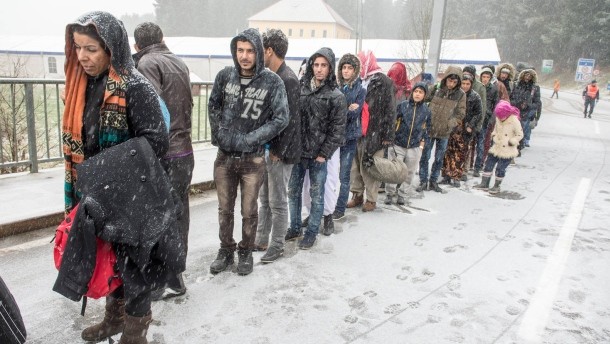
Refugees making their way to Germany through Austria
Sources: FT, FAZ, Bloomberg, France 24, DPA, AFP, Reuters, ALDE Party

