
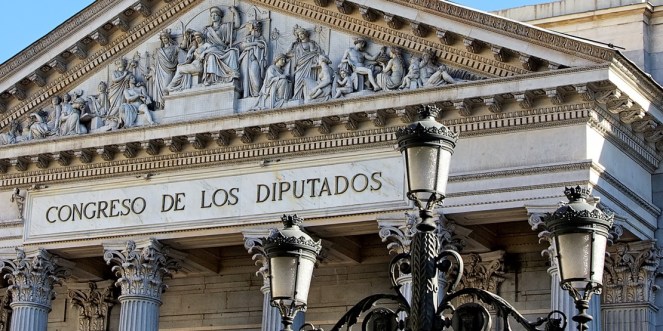
With the Spanish elections last month yielding a fractured Congreso de los Diputados, politics in Spain ground to a stand-still as an easy coalition to solve the issue seemed unlikely to be found. The two traditional parties’ hold over the Cortes Generales, which had entirely dominated Spanish democracy since its inception, was finally broken, with neither the Partido Popular (PP) under the incumbent Prime Minister Mariano Rajoy, nor Pedro Sánchez’s Partido Socialista Obrero Español (PSOE) gaining an absolute majority. The rise of 2 new parties, anti-austerity, leftist Podemos and centrist, liberal Cuidadanos (Cs), has made the issue of forming a coalition even more complicated. However, since we left the story back in December, a few developments have added to the ongoing struggle at the top of Spanish democracy.
With the parliament sitting for the first time since the elections on 14th January, the PP, having won the largest share of the vote, is still clinging onto its preeminent position in the struggle, in the vain hope of being able to form a government. Prime Minister Rajoy has even dropped his initial stance of being unwilling to cooperate with his opposite number in the PSOE, Mr Sánchez, instead switching to a message of desperate encouragement towards the Socialists of forming a coalition with him. According to PM Rajoy, further procrastination from centre-left party is just wasting time. The Prime Minister has good reason to want an increase in the tempo of the situation, as Professor Pablo Simon explains that PM Rajoy is in the most difficult position, considering he has few political allies in the Congress. Worse still, in a poll following the election, it appears that PM Rajoy’s plan of a German-style, Grand Coalition, is the least popular outcome among Spaniards; this is understandable, considering the obvious conclusion to be drawn by the Spanish voter that despite demanding change, this is the political Old Guard shoring up their position in response to the rise of new parties arguing for change. Not the most appealing prospect. Add to this the abysmal approval rating of Rajoy himself as a Prime Minister, party leader and politician, at it seems unlikely that the PP will be in government much longer, even if the Prime Minister steps down in favour of one of his deputies as the FAZ suggested was possible last month. Despite these woes, PM Rajoy has stuck to his line from just after the election, claiming “we’ve won the elections, and whoever wins the elections, must go on to build a government”.
Meanwhile, Pedro Sánchez seems even more resistant to an alliance with the PP than in December, with the PSOE repeatedly rejecting any overtures by the PP to form a government. In a perfect world this would be purely because of the public aversion to a Grand Coalition, however in the world of high politics you can bet that the voters, having had their say, will play a small part in the politicians’ thinking. If resisting the PP did not prevent the further hemorrhaging of leftist voters to Podemos, I can imagine Mr Sánchez being warmer to the prospect of a Grand Coalition. Instead, the PSOE looks to be turning left towards an alliance with Podemos and perhaps also the Cs. With this in mind, The Local reports that on Thursday 7th Jan, Mr Sánchez made a visit to his socialist colleague in Lisbon, leader of the Partido Socialista (PS) and Prime Minister António Costa, who orchestrating the ousting of the incumbent centre-right Partido Social Democrata (PSD) government under Pedro Passos Coelho. According to a socialist source, Mr Sánchez made the trip in order to consult his colleague in Lisbon on how the government was formed, and how it s currently getting on. The implication is clear; PSOE seems to want to be able to pull off a similar manoeuvre in Madrid. For all the potential posturing, it seems the Socialist leader wants to show the politicians in Madrid where the real power lies. Researcher Jose Ignacio Torreblanca explained in The Local that Mr Sánchez now holds all the cards in the ongoing negotiations. However, PSOE is divided on the issue; whilst receiving a letter from a series of parliamentarians in the Congress urging him to form an alliance with Podemos, Mr Sánchez must also consider the more moderate wing of the party and its leaders such as Susana Diaz, who The Local reports are more resistant to such a move. Podemos have already made it clear that they will extract major concessions from any coalition they are part of, which will undoubtedly involve resistance to the previous government’s German-encouraged Sparpolitik. Questions will rise as to whether this will put Spain’s economic recovery under threat; the FT reported last week that Spanish employment is up 13.8% last year, beating its annual target. PSOE will not want to be seen as putting that recovery on the line in order to win power.
As if the stalemate was not already drama-ridden enough, to add to the situation is the recent news from Catalonia last Sunday (10th), that the Separatist faction controlling the regional parliament had finally elected an official leader to initiate the independence procedure. Having rejected the previous front-man for the Separatist movement – Artur Mas – weeks of negotiations resulted in a last ditch attempt to save the pro-independence parliament, with the election of Carles Puigdemont to lead it. France 24 draws the comparison that events in Madrid now stand in stark contrast to those in Barcelona, who now have a leader with a clear objective, policies and a timetable of how to get there. Puigdemont’s government will now set about the process of forming independent state institutions to allow a clean break from Spain; according to Professor Simon, in light of these events, fresh elections in Madrid would now seem foolish and a waste of time, allowing the situation in the Catalan government to get out of hand. According to the Professor, the Catalan issue, economic uncertainty and pending reforms are all contributing to the paralysis of politics in Madrid. El Español recently said that the Separatists are benefiting from the power-vacuum to the south. Nonetheless, the events in Catalonia put pressure on politicians in Madrid to form a government. France 24 believes that the increased pressure will push PSOE towards the PP, and noises from both the traditional parties seem to agree with this (though there seems to be some difference as to how permanent such a coalition would be). Considering that Podemos is sympathetic to a Scotland-style referendum over the issue (which 7.5 million Catalans would like to see), this could put a strain on any PSOE-Podemos partnership, as if there weren’t enough potential problems.
Despite this, PSOE has spent too long resisting, posturing and deliberating to now go and form a coalition with PM Rajoy’s PP. Considering that they are the Prime Minister’s only potential ally in parliament with whom he could form a government, I sincerely doubt any presence of the PP in the next Spanish government. What this will mean for Spanish politics? For one thing, a likely change in economic policy, and a firm resistance of German-encouraged Sparpolitik. However without a common front in the form of a Grand Coalition, it seems that the Catalan question could become brutal and bloody; the Spanish Constitutional Court has already ruled the motion passed last year by the Catalan parliament as unconstitutional – however ever since the separatists gained control of the parliament they have said that the Court’s rulings no longer apply to the province. Spain has a difficult year ahead of it, but any shift from the current stalemate to tackling the actual issues will hinge on whether PSOE can form a workable coalition with Podemos, and build a stable government.
Sources: The Local, France 24, FAZ, FT

