
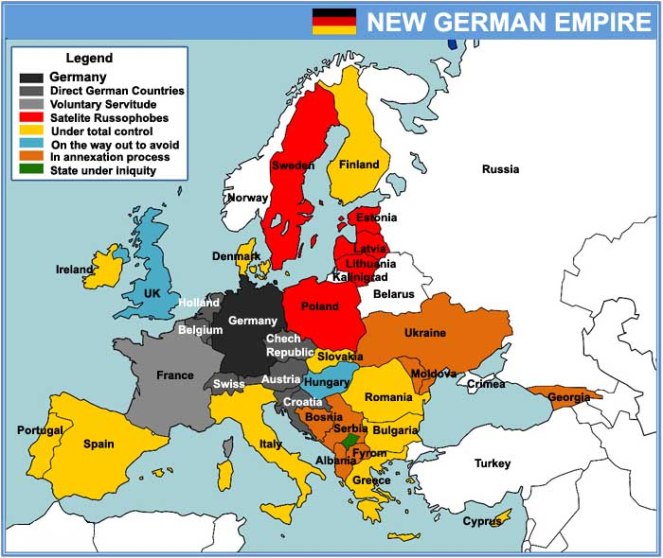
So, Germany are the strongest power in Europe; this, we all know. They are the most populous nation, have the single largest economy, and as an extent of this, the most political clout and pull in the Union. Along with that line of thought, usually the thought also goes that if Germany are opposed to something in Europe, it doesn’t happen. Greek debt being written off, particularly careless public spending, fiscal transfers – you name it, they can stop it.
I am not entirely convinced that Germany is the all-powerful control node of the EU, though I do accept that they are the most powerful nation in the Union and have taken the role of leadership thereof. German power has been growing ever since the European project was begun, providing the economic powerhouse of what was to become the European Union. By 1989, Germany already had the largest economy and population in Europe. Though not single-handedly holding the reigns of leadership as they do today, they still were one of the Union’s leaders. That was before the Reunification and Maastricht Treaty. Afterwards, Germany’s population rose, as did its economic potential and place in the Union, with a clear lead in the power it now wielded in comparison to its rivals; with the creation of the euro solidifying Germany’s economic hegemony and prime place of German austerity-economics in Europe’s modus operandi, Germany finally, in some strange coup intended to weaken Germany’s hegemonic status in the Union, achieved its position as the clearly most important voice in European affairs. Germany, with a current population of 80 million and 96 seats in the European Parliament, also have significant influence over the European People’s Party (EPP), who currently control the Commission. Couple this with Britain’s slow withdrawal from European affairs, France’s decline (accelerated by the Financial Crisis 2008) and eastern Europe emulating German neoliberalism in its own path to prosperity, and Germany found itself well in the clear as Europe’s firm leader. This, you cannot argue with. What you can argue with is the the conclusions you draw from the analysis.
It was in a conversation with a eurosceptic recently that I realised that this understanding of Germany goes deeper. My partner in conversation was under the impression that Germany’s current dominant position was always the case, has always been unchallenged, acts to convert the EU into some sort of vehicle for German foreign policy in the world, and thus (and worst of all) means that the EU is fundamentally wrong. The first two are debatable, I’d argue. The third, somewhat true, in the current context. The last is simply nonsense. Firstly, Germany may lead the Union now but they haven’t always had total power; France was perhaps the most important voice internationally in the 60s under President Charles de Gaulle (being the man to veto Britain’s application for membership twice) and certainly used the European project to advance France’s own foreign policy aims. When the EU didn’t play along, and did not accept French hegemony, de Gaulle simply said France wasn’t going to accept such a verdict, and pulled out, triggering the so-called ‘Empty Chair Crisis’. Meanwhile, whilst Britain never aspired to leadership of the Union, it certainly was a large player in the 80s; if you think they had Germany’s backing during the rebate arguments etc. you’re wrong. The implementation of the euro itself was against the advice of the German central bank (the Bundesbank).
Furthermore, even today, Germany’s hegemony is not absolute , in the sense that not all courses the Commission takes are sanctioned by Berlin. Crucially here, I talk abut the ECB, and its actions since the Financial Crisis. Despite being incredibly powerful in the level of independence it had stipulated in 1992, its powers have since grown, ultimately at the protest of the German government. The ECB is currently undertaking a Quantitative Easing (QE) programme, designed to pump huge quantities of cash into the Eurozone. Regardless of how effective this policy may be, Germany are not warm to the idea. Prior to this, the Monetary Union has become far more extensive than any German politician hoped it would be – the ESM (European Stability Mechanism), is a mechanism designed to borrow on behalf of the rich, high credit-rating states in order to lend to the weaker, poorer states. While not fiscal transfers, it is a huge step away from the idea that German politicians had for the eurozone, which they hoped would not make Germany responsible at all for the other states of the Union. The banking union is another example, particularly the potential for common deposit insurance, which is similar to the ESM in that it means deposits into banks in Greece will be backed up by banks in other countries and ultimately the European Central Bank. German resistance to showing the oft-brandished idea of ‘solidarity’ is worrying, but the European drive to enshrine it in the European modus operandi is a positive sign and also a sign of European resistance to current German hegemony.
It is this resistance, and the long-term viability of Germany’s leading position in the Union, to which I wish to turn. There are a series of reasons why German hegemony cannot last and there are many signs which point to this. I recently saw an article in Politico, titled “5 reasons why Germany’s influence is fading“, which is well worth read, and first brought to my attention the fact that my belief is now spreading to the press. It had 5 points, I have 3, and think that the majority of these points can be contained in them.
Electoral shifts in Europe
Germany and Chancellor Merkel’s CDU party’s bloc in Europe, the EPP, saw a series of setbacks in Europe last year. Greece was the first to fall, in January switching from Νέα Δημοκρατία (ND) to Συνασπισμός Ριζοσπαστικής Αριστεράς (SYRIZA). And though Athens got mauled in the crisis in July last year, their resistance to German demands has been noted across Europe. Then there were the October elections of Portugal and Poland, which led to Pedro Passos Coelho’s Partido Social Democrata (PSD) being defeated by an anti-austerity (or Sparpolitik as I like to call it) coalition led by the Partido Socialista (PS) – meanwhile Poland came out clearly defiant in its rejection of German neoliberalism imposed by the Platforma Obywatelska (PO), unfortunately in favour of the national-conservative Prawo i Sprawiedliwość (PiS) of Jarosław Kaczyński. Finally, we have the collapse of the absolute majority government under Mariano Rajoy’s Partido Popular (PP), in favour of a collection of anti-Sparpolitik and anti-old guard parties, including the more traditional Partido Socialista Obrero Español (PSOE), Podemos and Cuidadanos. The EPP and thus Chancellor Merkel’s political allies in Europe has fallen to Hungary’s Viktor Orbán, and Enda Kenny, who still remains Ireland’s Taoiseach. Not only has anti-German fervour spread across Europe, particularly centred around the issue of German-led Sparpolitik, but it has led to a loss of pro-EPP politics in Europe and an undermining of the previous neoliberal consensus. Merkel can no longer rely on political support from European electorates any longer. The chances of this trend shifting in 2016 is low to say the least.
Deteriorating allegiances in Europe
This leads onto my next issue, which has been witnessed in the disappointing election results for the Chancellor’s allies but has also been worsened by the events that shook Europe last year, for Merkel’s previous allies have critically been separated from the Chancellor, allies who did not have the same political allegiance and even those who have. The realignment most clearly seen by the end of last year in eastern Europe is the first example; with the German-Polish axis weakened by PiS’ rise to power, Prime Minister Orbán’s intense criticism of the German Chancellor, especially over her actions in the refugee crisis and her policy proposals there-related and the resulting strengthening of the Visegrád Bloc against the consensus in western Europe threatens to divide Europe along an east-west axis and has deprived Merkel of her eastern-European allies, crucial to upholding the 2004 enlargement of the Union eastwards. Obviously there are the political losses that I have just covered. But there are three more issues to contend with. Firstly, Brexit is a real potential threat to Chancellor Merkel in her role as the most powerful stateswoman in Europe, considering it threatens to destabilise the Union. A British withdrawal will likely precede a radical reshuffling of the political consensus in Europe that could well lead to a severely weakened position for Germany. It would also mean the loss of one of Germany’s most neoliberal-aligned allies. Secondly, France has also shown some signs to a split with Germany. It has become clear to journalists and professors that there is a real divide between Berlin and Paris over thinking on the move to fiscal union; Germany’s emphasis on the technocratic method could strain perhaps the most important alliance Germany has in the Union, that with France. Of course France is far off from posing a significant threat to German hegemony, and we as a Union are far away from further integration of that calibre. However, when that time comes, when France’s economy truly recovers and Europe’s citizenry learns to trust Europe again, that tension may arise. Hendrik Kafsack wrote in the FAZ last week “never has the end of the EU seemed so realistic” – what he means of course, is the end of Germany’s EU.
Finally, there are the recent criticisms of Italian Prime Minister Matteo Renzi. Prime Minister Renzi, leader of the centre-left Partito Democratico (PD) and de facto leader of the Party of European Socialists (PES), counter-weight and second largest group in the European Parliament behind Merkel’s EPP, has recently been attacking the status quo in the Union, firstly in interview with the FT in December. Even in July, during the height of the Greek Crisis, PM Renzi was showing his obvious disdain for the technocratic method employed by Germany in directing the Union. Since the December interview however, in which the Prime Minister said that austerity was fanning populist flames, PM Renzi has ‘sharpened his rhetorical barbs’ against the Commission, and was rebuked last Friday by Commission President Jean-Claude Juncker for demonising and criticising the Commission, according to the FT. The President said “I genuinely do feel that Italy should not be too ready to criticise the commission”. Italy also chose to block the €3bn package for Turkey to stem migrant flows, German opposition to a complete banking union with common deposit insurance, as well as the controversial German pipeline to Russia. The decision to block the money to Turkey has caused particular upset, but critically shows me that European leaders, if only one – for now – are slowly becoming willing to criticise the status quo in Europe, particularly Brussels and Berlin. If Rome has chosen to depart from Berlin, and repeatedly, then we have a real challenge to German hegemony, and the German question becomes a legitimate debate again. Politico reported on Monday the Prime Minister’s commenting, that Europe’s real centre of power is in Berlin; this is crucial to the debate and shaping of the EU. Politico also said that Italian members PES in the European parliament had been invited to Rome to a talk with the Prime Minister, and the group had turned to a more critical stance of the Juncker Commission and its support of German Sparpolitik. Many have attributed PM Renzi’s recent moves as a response to the culmination of a shift in public opinion in Italy. Regardless of the reason, I think the Prime Minister is in a prime position to take on the German consensus, but he must focus on Berlin rather than Brussels, the Chancellor rather than the Commission. Prime Minister Renzi is the most clear sign of a shift in the mood in European capitals, cited as so by Wolfgang Münchau in his article published on Sunday – Gloom gathers over the challenges that Germany faces.
The Merkel Chancellery’s crumbling domestic support
Most critically however, we have to realise that for the first time in over a decade, Germany’s establishment is politically divided; Merkel’s refugee policy has damaged her country’s political stability big time, and that means the common front that Germany’s politicians could once present to their opponents in Europe has now disappeared. Münchau’s article in the FT is focussed mainly on the difficulties the German government are facing this year, from the failing refugee policy, which he said was due to misjudged effects, reckless actions, or both. Nevertheless, it has led to a tough domestic situation in which 1 million refugees have entered the country, a situation which has been inflamed enormously with the assaults in Cologne on New Year’s Eve. I think crucially, what has made the Cologne situation a disaster is the authorities handling of it, from the lack of initial media coverage, police playing down and almost trying to hide what happened initially, to many Germans it appears to be a huge cover up orchestrated by the government (or some external leviathan-like power), designed to cover up the failings of the Chancellor’s refugee policy. Even for those who believed it was right t welcome refugees, I think we should all understand that there was no need for the Chancellor to announce to the world that all refugees from Syria would get immediate access to Germany, especially when Germany’s borders are already open. Despite the positive response from the assembled CDU parliamentarians at the party conference in Karlsruhe at the end of last year, there is no doubt that support across the Chancellor’s allies, from the CDU in the Bundestag, to her Ministers and the population at large are for the first time seriously questioning Ms. Merkel’s leadership. The FAZ reported on Monday a comment from the former CSU leader Edmund Stoiber, who said that the Chancellor had at best until the end of March to change her policy. What’s telling is that the FAZ used the word ‘ultimatum’ in describing the Bavarian politician’s statement – it really is one. He demanded a total closing of the German-Austrian border; even without this, without a noticeable reduction in the number of refugees entering the country – and we must consider that we are in the winter months now, its believed that the summer will bring another increase which could well be overwhelming – the Chancellor will almost certainly be facing a full-blown political crisis in the summer. It’s noble for Ms Merkel to have resisted calls to close the borders for so long, however all politicians must bow t politics, even the 10-year reigning German Chancellor. Crucially for the European level, a German government having to focus on domestic issues for the first time in years will mean they will be more exposed to attacks from the outside; in this sense, Matteo Renzi has chosen his timing well.
Germany is weakened domestically, and as Germany’s allies desert them one by one, and Sparpolitik regimes topple across the Union, so will German dominance of its politics.
Sources: FT, FAZ, Politico

