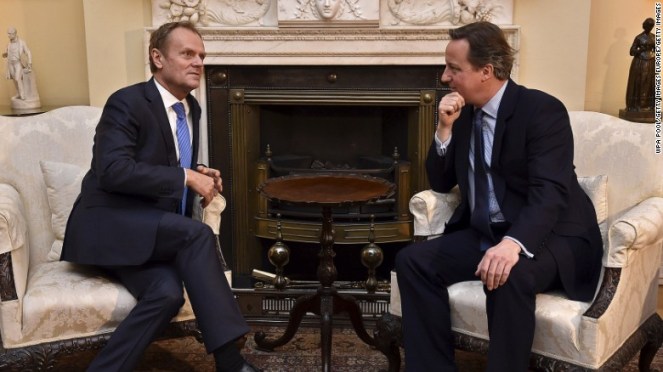
Donald Tusk, President of the European Council has today published the draft deal concluding months of negotiations between Britain and the European Union, as part of a first move to keep Britain in the UK. After David Cameron’s 45-minute speech in Brussels last December galvanised both sides into finding compromises and towards ending the negotiations, it seemed throughout January that there would be enough ‘goodwill’ (as was oft-repeated) to find a deal.
After marathon meetings over the weekend with Commission President Jean-Claude Juncker on Friday and President Donald Tusk on Sunday, the finer points of the deal were worked out and particularly for the sticky issue over a migrant-benefit ban, intense negotiations in the past couple of days finally produced something that both sides can work with. The letter has been described by the FT as “written in dense legal language”, however considering it is the basis for an international treaty, I think this is to be expected. President Tusk will now circulate the draft deal round the other 27 European capitals in order to win their approvals, in time for an emergency Brexit-summit on 18th February. Donald Tusk on Monday said that whilst this will likely not be the final deal that is agreed, it is something that can be worked with, analysed and discussed – the beginnings of a final product if you will.
In the letter sent by the Council President to all members of the European Council, published on consilium.europa.eu, the President opens by stating that “Keeping the unity of the European Union is the biggest challenge for all of us and so it is the key objective of my mandate.” According to President Tusk, the draft deal “goes really far in addressing all the concerns raised by Prime Minister Cameron”, without “[crossing] were principles on which the European project is founded.” In the letter itself President Tusk admits that this will not be the final deal but states that he believes it is the good basis for a compromise.
The Proposals
Eurozone-non-eurozone relations: in the letter President Tusk provides the basis for a mechanism whereby any conflict of interest between nations like Britain not part of the eurozone and the eurozone states will be discussed and reassurances made, in order to prevent lasting splits in the Union. Furthermore, policies designed to facilitate the deepening integration of the eurozone will not have to be adopted by non-euro states. Naturally there is a vagueness to the proposal, however this is a little disappointing seeing as this will widely be seen as the most lasting and important issue with regards to the governance of the Union. Seeing as this is a fault-line which will have to be faced eventually, I and others were hoping for a more robust mechanism that would ensure decisions were democratically legitimised and genuine compromises were found. The vagueness of “reassurances” seems a little flimsy to me. Where the President did come down a little harsher was his insistence that any mechanism will not constitute a veto or be used to impede legislation designed to deepen eurozone integration:
“Member States whose currency is not the euro shall not impede the implementation of legal acts directly linked to the functioning of the euro area and shall refrain from measures which could jeopardise the attainment of the objectives of the economic and monetary union.”
This clearly leans on the side of France, who were particularly concerned about a ‘back door veto for the city of London’, who it they (correctly) believed would try to delay eurozone financial regulation in the future. Speaking to an Italian diplomat at a conference at the university last year, I remember him saying that Europe needed a mechanism which facilitates the smooth running for a ‘two-pillar’ Europe, the emphasis being on the pillar, because unlike two-speed, two-pillar means that the two parts of Europe do not have the same destination. However, whilst President Tusk makes it clear that the actual workings of his proposed mechanism are still to be discussed, I cannot see yet whether it will be useful in making relations between the two parts of Europe more flexible.
Competitiveness: this was always going to be a meaningless one. Every country wants a competitive economy, everyone says ‘we’ll try to improve competitiveness’ and no one in Europe has ever said that it is unimportant. Nevertheless, its interest to see in writing that the EU admits that it has been a little to trigger-happy when it comes to regulations and that it will cut down on new legislation and try to cut red-tape:
“This means lowering administrative burdens and compliance costs on economic operators, especially small and medium enterprises, and repealing unnecessary legislation”.
Whether this is in fact the case or not remains to be seen. It’s important to note the Commission has been heading in this direction anyway; the Lisbon Agenda agreed in 2000 also wanted to make the EU more competitive – “the most competitive knowledge based economy in the world by 2010”. Of course at the time no one had foreseen the financial crash which would stall these efforts, but competitiveness has never been at the bottom of the European agenda. And yet that doesn’t make it easy. A commitment to achieving greater competitiveness doesn’t translate into 28 national parliaments all moving as one towards über-competitive economies, supported by a now laissez-faire Brussels bureaucracy, not that Brussels was the main obstacle to efficient economies anyway. It’s worth mentioning that the amount of legislation (that’s regulations, directives and decisions) has been falling in the past years, and in particular regulations have been falling since the mid 90s. An annual audit of EU regulation, intended to reduce it and interventions from Brussels in the long-term, will be a far more concrete step to reduce European regulation, however we’ll see how effective this audit is.
Power of National Parliaments: The first line of this part of the agreement is particularly damning to anyone who saw the “ever-closer-union” line as a call to increase the powers of EU insititutions; President Tusk delivers a broadside which whilst not counter to most peoples’ understanding I think, is pretty decisive:
“Therefore, the references to an ever closer union among the peoples of Europe do not offer a basis for extending the scope of any provision of the Treaties or of EU secondary legislation. They should not be used either to support an extensive interpretation of the competences of the Union or of the powers of its institutions as set out in the Treaties.”
This section also concedes the right of national parliaments, if they form a majority, to reject pieces of legislation passed by the European Parliament and Council. This empowerment of the national level against the European one, I’m sure, will hopefully never be tested, and will only be used as a threat by Ministers in the Council of the EU to revise legislation. It was widely approved of by other member-states, and whilst federalist might go crazy at the idea that national parliaments should have such a powerful voice at the European level, I must say I am more torn. Ultimately, national parliaments are democratically elected, have serious history behind them in most cases and represent the collective voice of Europe’s nations – these nations are represented by their ministers at the European level in the Council of the EU, but also I believe the national parliaments should have a say too. The EU’s Principle of Subsidiarity, Protocol 2 outlines that all national parliaments will have 2 votes, 1 vote per chamber for bicameral systems and 2 for the single chamber in unicameral systems. A majority of these votes will allow the legislation to be blocked. Whether this becomes the final system, I don’t know, however I think its a good addition to the role of national parliaments, and respects the equality of states and of the Union’s individual nations.
The Free Movement of labour and in-work benefits: the big one. The one which has by most accounts held up the process for the longest. Probably not the one with the most lasting impact overall but that’s the way with politics that something not so important becomes very important because it’s talked about enough. Anyway, the first major point from this section is the President still urging the UK to change its own welfare system to reduce the pull factor it has on migrants: “Member States have the right to define the fundamental principles of their social security systems” – in English ‘all you have to do is change your system”. President Tusk then grants legitimacy to a fear which has been circling in the British press and public over ‘welfare tourism’, with the following paragraph:
“The right of economically non active persons to reside in the host Member State depends under EU law on such persons having sufficient resources for themselves and their family members not to become a burden on the social assistance system of the host Member State and have comprehensive sickness insurance.”
This therefore means that migrants may be refused out of work benefits if they have moved to a country in order to gain access to their welfare system. How this will be accurately determined, I have no idea. From the paper, it seems that if you are out of work and not in your host country, you will not receive out-of-work benefits. Finally we get to the topic of in-work benefits. To reduce the amount of child benefit being exported abroad, a new piece of legislation will be passed, linking the child-benefit a worker receives to the standard of living in which his or her child resides. A sensible decision, which reduces the pull-factor that higher-paid countries have on foreign workers. The letter also has given the green light to the ’emergency brake’ allowing in exceptional circumstance member-states to restrict in-work benefits to EU migrant workers, to reduce strain on social systems:
“[an amendment] will provide for an alert and safeguard mechanism that responds to situations of inflow of workers from other Member States of an exceptional magnitude over an extended period of time.”
The mechanism would work by the Commission or Council permitting the restriction to a member-state which can demonstrate that its welfare systems are overwhelmed, and the restriction can be maintained for 4 years. So there you have it; PM Cameron got his 4-year ban. And if you don’t agree, the last section of the letter allows the changes to be implemented from the day Britain votes to remain in the Union.
According to the FT, conservative eurosceptics in the Commons have already denounced the agreement, and have been ever since it looked likely one would be met. The fact is, it’s clear they never wanted an agreement, they just wanted a Brexit. This is important, as the effectiveness of this deal – if it is passed – will hinge not on whether eurosceptic politicians agree, but on whether the British public do. I think this could work. The Prime Minister has shown that the EU is not as rigid as eurosceptics would have us believe, and that the UK clearly has some pull in the Union as lots of things have been accepted by the Commission that would not otherwise have been conceived of at any other time. Not all of this is trivial. Evidence is of reports that France and Poland are already showing concern about the potential powers now available, to block eurozone legislation for the former, and social welfare for the latter. Prime Minister Cameron hopes to allay these fears in another round of diplomacy in the coming weeks before the 18th. The test will be on the 18th itself, when we see just how skilled a diplomat the PM has become.