
Recently I had a lecture about Nations & Nationalism at university, which really made me think about the role of nations in the EU. The traditional argument from eurosceptics is ‘the EU destroys national sovereignty’. Farage on many occasions has accused Brussels of having a deep loathing for national democracy, and the supremacy of the nation state as the ultimate form of human organisation. I’ve heard this argument before, about how the nation-state has served humanity as the optimum form of human political organisation, and no other form can trump it. The term of disgust they spit at the EU; ‘the superstate’ – something unnatural and unwelcome. I agree with them that the nation-states of Europe have an important role to play in the European Union, and ultimately the position of the nation-state in the Union is of paramount importance, and has to be clearly defined, as any federation has to determine the powers of its constituent states. There is an argument that as nations, the member-states of the EU deserve more powers than, say, the Bundesländer in Germany, or the provinces in Canada. However what is less clear, is whether the European nation-states are any more ‘natural’ than the EU. I believe that beyond the normative level, they are not.
In academics, when it comes to nations there are 2 sides of the argument – the Essentialists, and the Constructivists. The essentialists argue that the nation has always been there, is a natural construct which develops by itself, until eventually it creates its predestined political form. It’s ‘supposed’ to happen, nations are natural and should be the basis from which humans organise political life. Then we have the constructivists, who argue that in fact, nations are constructed, through education, myths, civic duties such as voting and conscription, borders and citizenship. They have to be built for people to see them. There is support for both sides – the Czech Republic has never in history been a sovereign nation, and yet the Czechs have existed as a people, to the point where given the choice, they formed their own sovereign state in the 20th Century. Likewise, it could be argued that for hundreds of years the German nation had no political entity to preserve it, and yet people spoke of Germans and in the 19th Century were able to form a nation-state, whose bonds were unbreakable, even after 40 years of division.
Looking closer however, we see other factors at play. France is one of the most prime examples of the constructed nation, which emerged from the dynastic, medieval period a state which was bound by having a historical monarch, and little else. The Bretons in the far-western regions of France, spoke a completely different language and had a completely different culture to those in the south of France, the Occitans, whose language was again very different from that of the centre, around Paris. Ultimately, France was not built from a collection of lands sharing culture and language, but was forced together under successive monarchs who were building an empire in Europe, similar to what Austria were doing around the same period – except instead, they failed. Why the Austrians failed whilst the French won is up in the air – perhaps they had a more effective policy for nation building, perhaps the national identities of the Occitans and Bretons (among others) was weaker, perhaps the disparate regions of France were bound together longer and so the idea of Frenchness seeped in for longer. An important fact here is that France focussed for much of the post-1789 period on building the civic nation; that is, a nation which focusses on shared civic values of a group of people, such as political rights, human rights and the defined roles of institutions, to form the national identity. The French concept of Laïcité is a prime example of this; the word is used for the French idea of secularism. It is specifically a French concept that has been spread across the country and thus adopted by people from Paris to Marseilles to Nantes, and something not linked to traditions or symbols, but ideas which everyone can adopt an embrace. In this way, the French state built an identity that was supposed to transcend race, ethnicity, symbols or culture, because ‘here’s something we can all understand’. Couple these ideas with the fresh start that the revolution gave France, and you can see one reason why it was perhaps easier for the French to impose their idea of the nation on all those disparate citizens ruled from Paris.
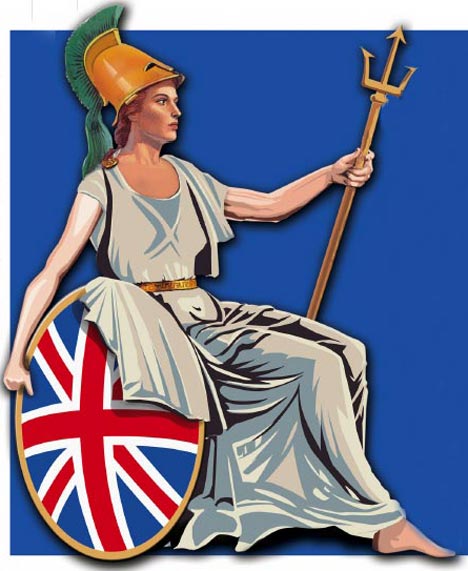
A different example might be with Britain – Britain was a name used by the Romans to refer to those living on the British isles, or the Roman province of Britannia. Here was something historic and natural that preexisted the nation state and seems to give evidence to the essentialist camp – except for the fact that Britannia didn’t include Ireland or Scotland, which both were part of the British state at some point. Here, it has been argued that the tool used to bond the peoples of Britain together was religion; specifically protestantism that rose up in the reformation. The Church of England and protestantism in general was a concept that all Britons could get behind, in their shared hatred of the Catholic Church. This explains why Ireland was never fully subjugated by British nationhood, in the same way that Northern Ireland, Scotland and Wales were – because huge parts of Ireland remained Catholic after the Reformation in the 1500s and 1600s. It also explains why the bonds of nationhood are crumbling now, as evidenced by Scotland’s referendum in 2014 to become an independent nation; that religious connection has slowly but certainly faded, to the point that Scots to not feel the same bonds of connection to their Welsh and English brothers and sisters in the south that they once felt. An important point here is that whilst nationality as a natural concept doesn’t exist, I think ethnicity does, in that ethnicity is much more based on shared culture, language, symbols and traditions, that people who live close by to each other adopt. This can be expanded upon and exploded into a nation-state, but that process isn’t natural by artificial. I won’t go into the reasons why nations were created here, but suffice to say that the only difference between Britain & France and the EU, is that they were created first and so the bonds of nationhood have had longer to be reinforced and seep in, to the point that it seems ‘the nation was always there’ and of course, the EU was not.
What is the significance of this fact today. Well first of all, it means that given time, a European identity can be created, which people might one day be able to truly relate with and want to defend, in ways that French, German and Spanish patriots do today. It also means that this idea that the nation is the best form of governance for humans because it’s natural is utter nonsense, and is no argument against the idea of the EU. Ultimately, why is are European nation-states more legitimate than the EU? Beyond longevity, there isn’t much of an argument. Of course, that is underplaying the impact of longevity; it creates trust between peoples separated by hundreds of miles, and between the people and the governing institutions. It has the impact of making people believe that the state was always there and is thus more natural, which goes back to the trust idea – nations to most people seem to make more sense. However from a practical stand point, there isn’t much more of an argument. Nations in Europe are of course small, but population doesn’t seem to have an impact on what constitutes a nation on the international stage. Is ‘American’ a nationality? Because if so, then it is a far bigger nation that the European ones, which seems to suggest that you can’t argue for a nation because it is more manageable than a ‘superstate’. The same goes doubly for China, or India. The idea that nation-states are any better than a European Union positively is a non-starter when looking at it.
However, this does not mean that we should begin constructing a European nationality. This would ultimately go against the founding principles of the European project and would undermine its legitimacy in my mind. Also, it would be nigh impossible. Yes, I just argued that creating a European ‘nation’ would be possible. But considering that Britain is already resisting the European project to a major degree (can’t even stand the symbolic line “ever-closer-union” for example), and the fact that we have accepted, as in the case of Scotland, Hungary and Catalonia that identities can survive centuries of being incorporated into a greater national identity, I sincerely doubt that European nationality could supersede existing ones permanently and without incident.
As I said before, this wouldn’t be desirable anyway; the European project was about mutual respect, shared values and cooperation between nations, it was never supposed to replace them. Even if you are among the federalists who argue that the European project was always a political one, (which I agree with) with the ultimate goal of forming a traditional federal union, (which I am more sceptical about), you cannot deny that the European project was not about replacing or eradicating the European nations. Nationalism yes, the idea of the nations no. If anything, by trying to do the latter you’d have severely less chance of achieving the former. No, I believe that Europe must take a different path if it wants to form a more unitary state, one which does not eradicate nations but preserves the idea that nations can cooperate in a single political body. From anything, ties to the nation are not merely ignorant; the historic nations of Europe are the entities which won Europeans freedoms, rights, democracy, the rule of law, and the freedom of thought, expression, and association. They are the ones which fought against tyranny, and whilst not perfect, are the entities which protect people from arbitrary tyrants. They are by no means perfect, but those constitutions mean something. The point being, and I take my lead from Jürgen Habermas here, and his book The Lure of Technocracy, that whilst in normal federations, the federal states are created by the nation (in the national assemblies and constitution-forming process), a European federation would be created by the nations themselves, and then become constituent states. They are what gives the federation power, and in doing so cannot be completely disarmed themselves. I say this not only literally (in terms of military power), but also in terms of the rights they have. There are a series of powers that the member-states of the EU have and should have, which normal federal states (such as those in America, Canada or Germany) do not have. For example, those nations should always have the sovereign right to leave the federation. They should also have a right to use legitimate force in order to enforce law and protect the state. EU member-states currently have the right to oversee the implementation of European laws, specifically how it is implemented in their individual countries and this is also important. The nations of Europe cannot be stripped of their nationhood, even if they lose their complete sovereignty in pooling it with their neighbours. A ‘United States of Europe’ is not possible or desirable. A Union of European Nations however, is what the European project was originally about, and must be remembered by all those involved in taking Europeans further down that path.


Worth remembering that the concept of nation is fuzzy. You can’t point to every individual, and allocate them a single nationality: some are born of parents from different nationalities, or born in one country and raised in another, and so on.
With countries, it’s different. You can point to any plot of land, and decide which country it is in. It does get complicated in some places: especially on borders, and especially where enclaves exist. And, borders change through time. So the Rhineland problem makes it very different to argue that France was constructed, but Germany was not. The settlement of that border means that one process applied to both countries.
And, of course, if nations are fuzzy, and countries are not, then you can’t have a state that maps a nation to a country. So, if the German nation has arisen naturally, you can’t say the same thing about Germany.
LikeLike
Well this is my point exactly; the two idea get confused easily and people say they are natural when they are not. If we take nation to mean the ethnic group, then yes they are fuzzy, and by creating countries with borders and citizenships, the leaders at the time hoped to make the nations less fuzzy, for their own political purposes. The intention of those borders, national myths, education etc. was to get to a point when nations could be mapped onto countries, so that one could say that they are both interchangeable with each other, and crucial, natural, inarguable entities.
LikeLike