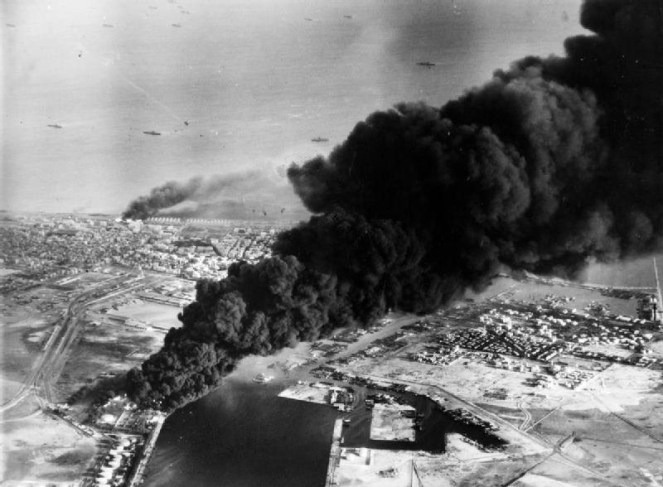
Almost 60 years ago, in late 1956, rolling across the sand not far from the Suez Canal, British paratroopers received the order they were to stand down and withdraw from the operation they were in the middle of conducting. This no doubt seemed strange to them as the operation was progressing so well; the Egyptian forces had been defeated at Port Said with barely over 100 British casualties (to the Egyptians’ around 8000), and it seemed the Suez Canal would be once more in Anglo-French hands within a day. However despite Britain winning the military battle, the political and economic battleground had seen Britain routed from the field. The US, USSR and the UN had all stood up to British and French ‘imperialist aggression’, British actions had received no support in the UN Security Council, it had quickly become clear that the British pretext for the invasion was utter nonsense, the British Prime Minister Anthony Eden had lied through his teeth to the British public over his desire for a war and 30,000 protested against the war in Trafalgar Square. Meanwhile, the Bank of England had lost $45 million as a result of the crisis, which, combined with a US threat to begin selling off US government bond holdings in Sterling, had the potential of putting serious downward pressure on the pound to the point that it would destroy Britain’s capacity to import essential food and energy, and Saudi Arabia decided to implement an oil embargo on Britain which the US refused to fill the gap for. By January Anthony Eden had resigned, Egypt sovereignty over the canal was confirmed, and Britain had suffered its worst international setback since Neville Chamberlain’s claim of ‘peace in our time’ was blown sky high by the German occupation of Czechoslovakia.
The events described above marked the end of the illusion that Britannia still ruled the waves; that Britain was a world power with global influence; that Britain could set the tone of the world. Britain’s leaders had been shown as incompetent, reckless, indecisive and out of touch. They had been shown to be living in a different world, where they could conjure up a whole load of lies to get the masses onside, where what they told elected parliamentarians was irrelevant, where the toppling of foreign statesmen was acceptable and where the defiance of an ‘inferior state’ was to be met with invasion and a good lesson on who’s boss. After the disastrous invasion of Egypt over the Suez Canal, once for Britain the East-West dividing line of the largest empire the world had ever seen, Great Britain herself was given a good lesson on who’s boss. Nevertheless, it seems like a lesson that was not well remembered.
Of course the aftermath of the Suez Crisis reverberated down the decades for Britain, leaving a permanent scar for at least 3 decades. However as we see finally the publication of the Chilcot Report, it seems the lessons from Suez were utterly forgotten by Tony Blair and his New Labour government. Perhaps criticising the whole government is unfair considering the report itself states that far too much of the decision making with regards to Iraq was taken by the Prime Minister and not given due discussion and consideration by the Cabinet. Nevertheless, some observers might have thought ‘we’ve seen this show already, and it did not end well’. In all seriousness, the parallels between the build up to Iraq and Suez are strikingly similar. The intention to topple a foreign statesman in the Middle East, the sheer arrogance shown by the Western powers, who on almost entirely false pretences made the case for invasion, lying to their electorates, and their elected assemblies. The speed at which the invasion was carried out, due to the entirely one-sided nature of the opposing, and thus the resulting divergent body count. The fact that Britain and the US garnered no support in the UN Security Council.
It’s frankly more than disappointing that British leaders twice in less than a half century made a catastrophic miscalculation, one which had disastrous consequences for Britain’s reputation international, the other which left a country, if not much of the Middle East in ruins. Perhaps the parallels between the leaders is important here, specifically the power they assumed they still had in world affairs, the sheer hubris with which they thought they could conduct Britain in the world. Eden assumed the British Empire, now under severe strain and looking more and more like an anachronism, could still do whatever it wanted in the world, still assumed he could invade another country to teach its leaders a lesson, and the international community would be behind him – he still believed the British people and the rest of the world would simply accept the nonsense he had cooked up to make everything look kosher. Unlike Eden, come 2003, Blair had accepted that Britain would never be one of the world’s leading powers, but at least by being America’s stooge, he thought, Britain would gain some extra influence in the world. However like Eden, Blair also made many astounding assumptions. That he could influence in some way American policy making, that the preparations made would be enough for Britain’s role in the conflict and in the occupation, that the British armed forces could reasonably manage its deployment in Iraq and Afghanistan, and once again, that the electorate and the parliament would bow their heads and accept the ‘intelligence’ dossiers, the half-baked justifications made by his government to bring things just far enough along to make the process unstoppable.
Both Suez and Iraq interminably scarred Britain’s international standing and the reputation of its once pragmatic and capable leadership. It made the British political class look completely out of touch with what the British people wanted, and what Britain was then capable of. Chilcot is the most damning report of its kind, and closes the question on whether Britain’s involvement in the Iraq conflict was at all justified or appropriate. And as is quickly becoming the case, Brexit is another of this fatal blunders made by an overconfident and short-sighted British Prime Minister. David Cameron too took reckless chances, gambling on his own ability, and completely misjudging the mood of the country. Both major political parties are a shambles, those responsible for the state we are in have fled the scene, and most appallingly, there is no plan to execute a withdrawal from the EU. We aren’t even sure if the referendum was enough legally to begin the process. Britain has yet again embarrassed itself; not for voting the way it did, but for doing so on the back on lies, and for those lies being peddled by people who didn’t even have a plan for if they won. Even after 60 years of losing its status as a world-shaping power, Britain still hasn’t worked out what it is, and where its place is in the world. Iraq demonstrated what happens if we cling to America, and the vote on 23rd June is apparently a no to Europe, our closest cultural and geopolitical friends. Some have advocated going back to the Commonwealth, but you’d only have to ask Anthony Eden to realise Britain really can’t rely on the Empire any more. For now, whilst we go for this trans-formative phase, we will continue to have to ponder. It seems that traditional British moderate evolution has been of no help to Britain since Suez. Instead, as Fintan O’Toole wrote recently in The Irish Times, it’s perhaps better to see the Brexit vote in June as the start of a political revolution in this country that has been long over due.