
Greece is currently in the midst of economic reforms in order for it to win the confidence of international investors again, get its economy back on track and more immediately win the next €86bn bailout package. However the last round of reforms is by all accounts the most difficult one as it entails major cuts and changes to the Greek pensions system, regarded as one of the corner stones of the Greek political establishment and major obstacles to a fluid free-market economy. Meanwhile, in the Greek opposition, Νέα Δημοκρατία (New Democracy/ND) has recently elected Kyriakos Mitsotakis as their leader in the hopes of reinvigorating the Greek centre-right.
Old Questions
Greece presented its latest proposal for pension-reforms to the their Troika debtors on the 5th January, which entails a unified social welfare system, including a consolidation of pension funds, and average cuts of 15% for future pensions. It’s difficult to see newspaper articles using words ‘submitted for approval’ in regards to a bill by a sovereign country’s parliament to a Troika of enormous capitalist interests. Likewise it’s easy to see Germany’s actions last summer as bullying, and the overall Greek affair as a terrible example of why the EU and modern capitalism is terrible for the little people, who seem to be getting stepped on in the name of powers beyond anyone’s control, and from which few benefit. However Greece’s case is different. Having read the online Greek News site MacroPolis (which helpfully is written for English speakers), I see that in fact, the Greek economic woes are really linked to an old-fashioned and intensely rigid establishment, which has political dynasties, corruption, a enormous bureaucracy (last figures I saw put the figure at around 800,000, though that might be including all public servants), and overall, a broken system. Hence, the demands of the Troika to cut the size of the civil service and particularly the pension schemes of the government, in order to reduce the national debt. But it’s not just the Troika, or Germany, or far-away European politicians who want to reform Greece’s economy, but Greeks themselves. Indeed, this is their establishment which they’ve become fed up with as many electorates have. So the idea that demanding reforms of this system are somehow completely evil-minded is nonsense.
However, as the current Greek Minister of Finance, Euclid Tsakalotos, made clear on Sunday, Greece needs room to manoeuvre here. Tsakalotos says it’s to prevent further pension cuts, and that is one side of things. Anyone who thinks that a decades-old system can be overhauled in a couple of years is fooling themselves and Greece does need time to move itself in the right direction here, and look like it is the Greek government and politicians who are making this happen, without constantly being hounded from international lenders. No matter the political will behind it these reforms will take time. It’s pretty obvious why Prime Minister Tsipras left the major hurdle of far-reaching pensions reforms until later; Greece needs to warm up to the idea that these reforms have to happen. It’s already taken over 5 years. Greece has been struggling to implement actual reforms since the crisis truly struck in 2010. So far, all the parties in the Hellenic Parliament have said that their will vote against them when the time comes, which is believed to be in January some time. Despite these ominous signs, as Guy Verhofstadt emphasised in the summer, by winning 2 elections and a referendum, no one is more qualified and has a stronger mandate from the Greek people than Alexis Tsipras. The fact he won the September elections after having campaigned in the referendum to reject the Troika’s proposed reforms shows that he has the support of the Greek people, so while I say this will take time, and must be allowed to take time, the Prime Minister still needs to seize the moment – this is his task to accomplish.
The Prime Minister made a widely published statement on 3rd January, published by most outlets, calling for the international lenders not to make unreasonable demands. The aim of the Syriza government to instead focus on cuts to future pensions (and hence future generations) seems to be their way to get around the difficult issue of pension reform, according to MacroPolis. However it’s also economically expedient, as cutting people’s wages now that they’ve become used to is no way to boost Greek confidence in their economy or demand. Despite the obvious calls that will come from the opposition that Syriza are hurting Greece’s future generations, they will be weaker than the cries of indignation that would have come from cuts targeted for the present. The main question here is, as Prime Minister Tsipras alluded to, whether the Troika will see this proposal as compliance with their demands, or whether they will demand something more unreasonable. And it would be unreasonable. Considering that on Thursday lawyers marched on the streets of Athens protesting the reforms, farmers planning to follow suit (considering that with the pension reforms will come tax increases for farmers) and, according to Kathimerini, the largest labour union in Greece is also considering strikes over the issue, the idea that Greece’s creditors would force Greece to go further is most certainly unreasonable. Furthermore, the FAZ reported Greece’s central bank chief Ioannis Stournaras having said also on 3rd Jan that further strife with Greece’s partners in the Eurozone could push the Greek people over the limit, and into a deeper crisis. Ultimately, Greece’s people trusted Tsipras’ government, to whatever extent that was, to get on with the reforms that he had signed them up to. Likewise, the Troika and EU must also trust the Syriza government to make these changes happen, and not break the trust Tsipras has managed to earn for him.
New Faces
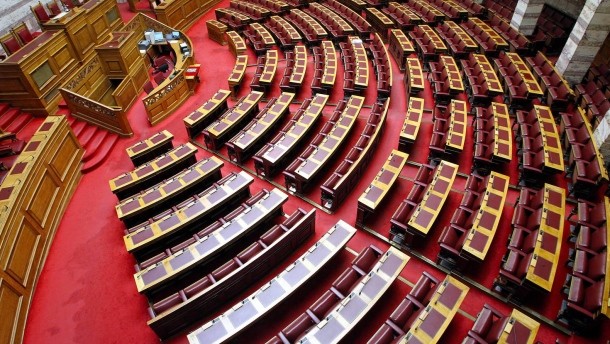
On the other side of the isle in the Hellenic parliament, we have Νέα Δημοκρατία (ND), now under the command of Mitsotakis. According to Kathimerini, this spells bad news in the short term, and good news in the long. The good news is that Mitsotakis is considered by all accounts and liberal reformer and one of the most competent ministers in the Grand Coalition government that Syriza’s win ousted last January. He supports reforms to the major issues plaguing Greece – bureaucracy, vested interests, restrictive economy. The fear of thinking that’s the end of the story however is what makes observers in Athens worried, as in fact, Mitsotakis’ win represents a new centre of gravity for Greece’s voters ad parliamentarians, who have not had a credible alternative to Tsipras since January last year. Now, the delicate balance in the Hellenic parliament has been shifted, with smaller parties less willing to go along with the Syriza line, less voters the same, which ultimately means Tsipras is not pre-destined to win any Greek election called to reinforce his majority. Likewise, votes in parliament aren’t necessarily going to gravitate towards him either. Kathimerini journalist Hugo Dixon also fears the potential of Tsipras to turn towards a tougher stance with the Troika, in an appeal to voters and parliamentarians, and the Troika to Tsipras, considering there is now the potential of replacing him. Thus, a consolidated opposition could prove more trouble than it’s worth in the turbulent world of Greek politics. As if to echo the words of Dixon’s fears, FAZ journalist, Tobias Piller, wrote on 7th Jan all the things you’d expect the German government, IMF and ECB to say – that he’s a reformer, western in his outlook, a liberal and most crucially, a ‘credible alternative’ to the current Prime Minister. MacroPolis wrote an article after his victory that there is the fear that Mitsotakis starts being portrayed by the west as the reformist white knight that they’ve been waiting for and kept getting wrong for the past 5 years. The fact is, they do have a dark knight here; as reluctant as he is, Tsipras is going through the reforms and getting them passed, one by one. Discounting this, when the man has a mandate greater than any politician around at the moment, is dangerous. If Mitsotakis really wants to be the reformer he and others say he is, then what he needs to do is rally the Greek parliamentarians, and hold Tsipras to account by making sure the reforms are effective, targeted and most crucially passed. By playing politics and trying to get the country to swing towards him, he will critically undermine Greece’s reform push.
Sources: MacroPolis, FAZ, FT, Kathimerini

